ITEM: PM Carney says in addition putting $1 billion toward the FIFA World Cup games in Toronto and Vancouver, his government will put $755 million over the next five years into developing soccer at all levels in Canada. Much of this money, $660 million, is earmarked for local sport organizations to grow and develop children and youth soccer programs. (Toronto Star here)
What else could $1 billion buy for Canada’s children and youth? What about providing one decent meal a day, a school lunch? In the last two years, the government has begun to take child poverty more seriously. The feds partially fund school lunch programs in all the provinces; the provinces also have to put up money. The aim is to help fight child poverty, as one-third of Canada’s children go to school hungry.
Here is a rundown of what four of the other G7 countries do to provide school meals for children.
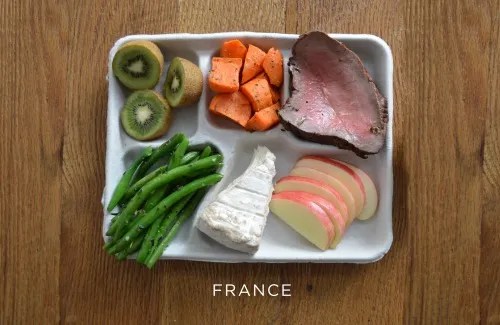
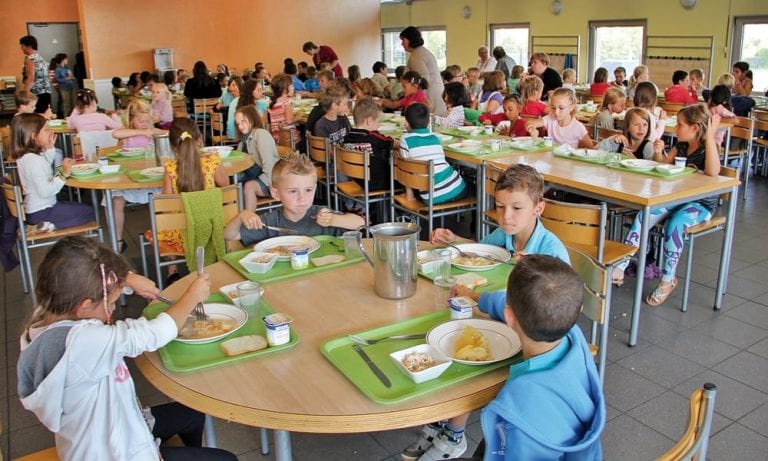
Wow: School Lunch programs in France & Italy
Here are examples of three G7 countries that “do lunch” for students particularly in elementary school.
Both France and Italy do it right. So does Japan. Not so much the UK!
In each country, there is a nutritionist teacher or monitor in every school in the country. Consulting with school officials, families and probably the kids, they plan weekly lunch menus of three courses for all the students and the staff.
The food is prepared –not centrally –but in the schools themselves by trained a chef (in the white outfit) and a small staff of helpers in white smocks with hairnets.
In France, kids cola
Filmmaker Michael Moore in his film Where to Invade Next (2015) sits down at a low round table surrounded by six children in elementary school in a town in northern France.
It’s a typical school day. Kitchen wait staff serves each child a starter, then a main course with vegetables. There’s even the sacred culinary tradition of the cheese course served before dessert! The children’s plates are china, and they use real cutlery. No paper plates, no plastic forks, no packaged condiments. The server pours each child a small glass of water – and I mean a glass, not a Styrofoam cup, not a travel mug. The kids are excited to have the American filmmaker join them. At one point, Moore pulls out a can of Coca Cola and asks if any child would like to have a bit. The kids look and shake their heads, no. It seems to us viewers as though no one had drunk a Coke before. It hits me, and probably 90% of other Canadians, as impossible! Come on, Moore cajoles—wouldn’t anybody like to try some ‘contraband’ as he calls it? One girl, around age 8, takes a sip. She makes a face to say it’s nothing special. The other kids ignore the Coke and turn back to their meals.
The children learn to eat politely with the proper knife and fork, and with time for conversation. No playing or running around the table; no throwing paper airplanes or twanging elastics at each other. Teachers, or at least classroom assistants, eat with the kids. Lunch may take a half hour – then the kids go outside to play.
This happens every day of the school year. There is no direct cost to the families for lunch. Something similar happens in Italy.
Magical lunches in Italy
In the northern Italy, near Verona, academic and author Tim Parks (originally from the UK) writes in his memoir An Italian Education (1995) about his own family’s decade of experience with school meals. All three of his children, he writes, enjoyed school meals. The food was typical of the high quality and variety of Italian cuisine. In his children’s school, as in many others, there was a parents’ committee of the home and school association that discussed the quality, quantity and variety of school meals every month. And every month, the chef distributed a menu plan. Parks notes how amazed he was that parents – or any grownups—were willing to sit through evening meetings to discuss the food their children would eat during the month. Lunch at schools is provided to everyone at the school, for free. The nutritionist/educator also teaches a program in the school about the importance of food, Italian culture and agriculture.
Typical school lunch in ItalyChildren sitting & enjoying lunch in Italy
“Thatcher, Thatcher, milk snatcher”
At the schools Parks attended as a youngster in England, school dinners consisted of shepherd’s pie and mushy tinned peas or beans in a sweet tomato sauce on white toast with overcooked brussel sprouts. There was usually a warm sticky pudding with sauce for dessert. School dinners were instituted to boost the health of Britons during the building of the welfare state in the wake of WWII; the dinners were a good attempt to feed all school age children a daily ‘healthy’ meal that many parents could not provide. Each dinner also included a small carton of milk — a note here: in 1971 when Margaret Thatcher was a Tory Cabinet minister in charge of education, she eliminated the free milk given to children age 7-11 because it was too expensive. Ridiculing her parsimony, her detractors called her, “Thatcher, Thatcher, milk snatcher.”
My son Max, went to school in England from age four to eight. At first he didn’t want to go to school. He was scared he would have to stay at school overnight since he thought the noontime “dinner” was served at nighttime. No, no we assured him — a main meal called dinner was served at lunch time. Turned out as Parks noted, school dinners – though free or low cost – were still atrocious.
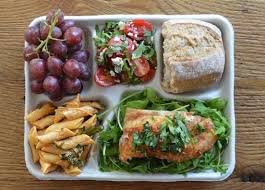
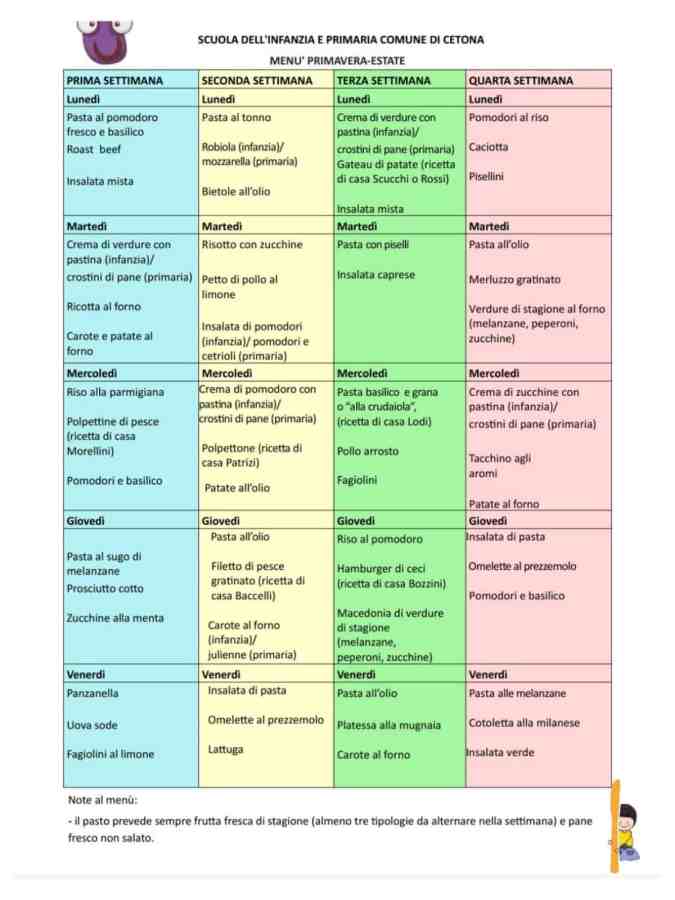
Recently, a mother with four children in Italian schools reproduced this monthly school menu. In the first week of the monthly schedule, on Monday, the lunch comprises of a starter of pasta with tomatoes and basil, the main course is roast beef followed by a mixed salad. Another lunch (in the fourth week) is pasta and olive oil, cod in a crunchy crust of breadcrumbs, and oven-roasted seasonal vegetables of eggplant, peppers and zucchini. Dessert is usually fresh fruit, or a fruit tart.
“A Typical Italian School Lunch Menu“
If a child isn’t feeling well or just getting over an illness, a parent can ask for a “white meal”:
“… un pasto in bianco“, meaning a “white meal” that is made without seasoning and items that can upset the stomach. It usually means pasta with olive oil and butter, mashed potatoes and some chicken breast. If you have allergies or intolerances, there will always be accommodations made.”
“And when I mentioned that drinking plain milk in a bottle like this was also something new to me, they [the students] gave me a lecture about calcium!”
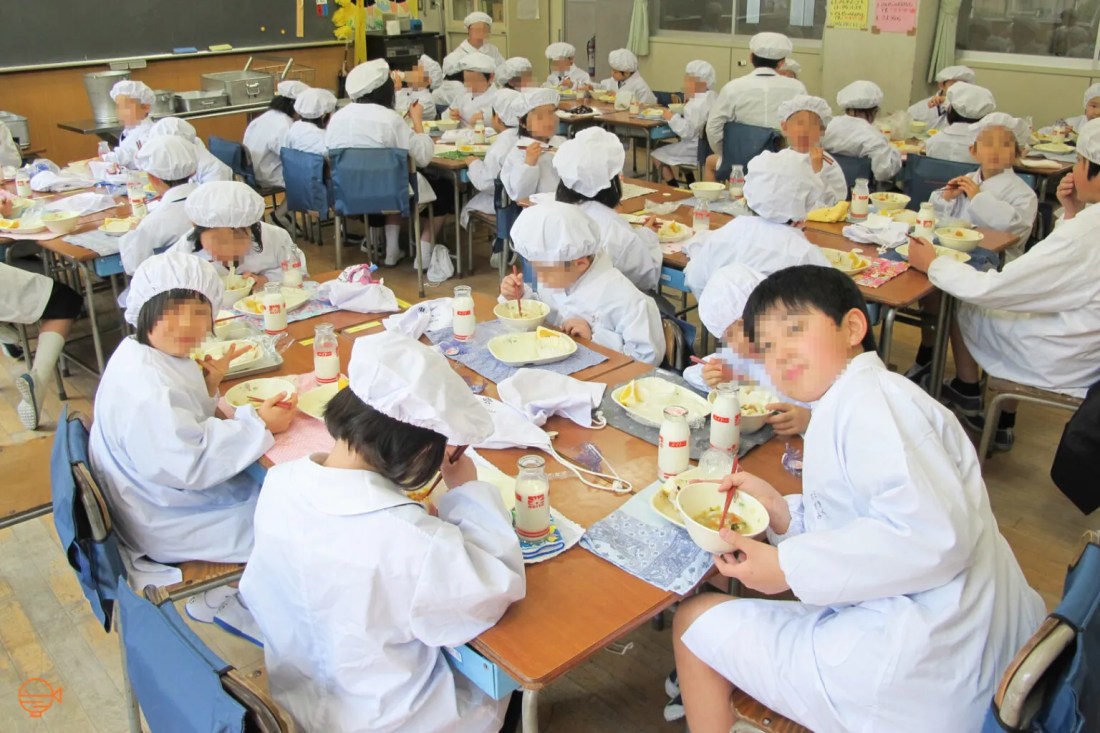
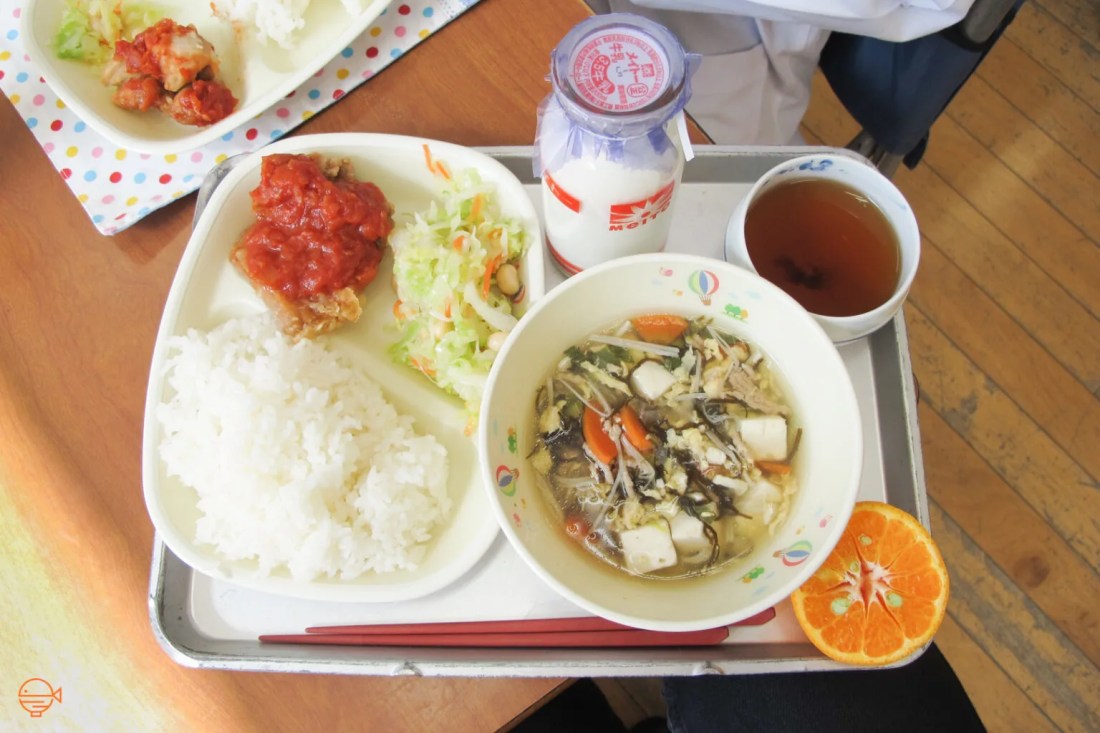
Japan: Note the small individual milk bottles at each placeJapan: Traditional school lunch, with chopsticks and green tea
In Japan, every elementary school has a nutritionist, a cook and staff to prepare the lunch time meals. It is the children – as young as Grade One kids—who learn to serve the other students, and their teacher at her desk. The children roll trolleys of plated foot, cold milk in small glass bottles and green tea. There is always a soup with vegetables and tofu, a side of rice or noodles, a small salad or vegetables and a main course of fish or meat. Dessert is fruit. An American teacher who worked in Japan remembers her students asking,
“Teacher, don’t you have school lunch in your country?” “No, we usually have to bring our own food from home or buy food from the canteen.” When I told them the usual foods that are available at the school tuck shop, they replied, “Gosh, how sad.” And when I mentioned that drinking plain milk in a bottle like this was also something new to me, they gave me a lecture about calcium!”
The children also have to tidy the classroom, push the desks together and wipe them, so they can socialize. They have to bring all the dirty dishes and glassware back to the kitchen at the end of lunch and make sure the classroom is clean for the afternoon classes. The kids – the servers for the day and the student diners don white smocks and hats for lunch; they each bring a placemat, a facecloth and a napkin from home. Lunches are not free – for elementary children the cost is about $2.50 a day; high schoolers pay about $5.00.
In addition, there is a nutrition-teacher in every Japanese elementary school who teaches a course on “eating education” or Shoku-iku starting in kindergarten. Students at all ages learn to:
Never skip breakfast.
Avoid buying food from convenience stores.
Choose a traditional Japanese meal over fast food.
Chaos in the Cafeteria
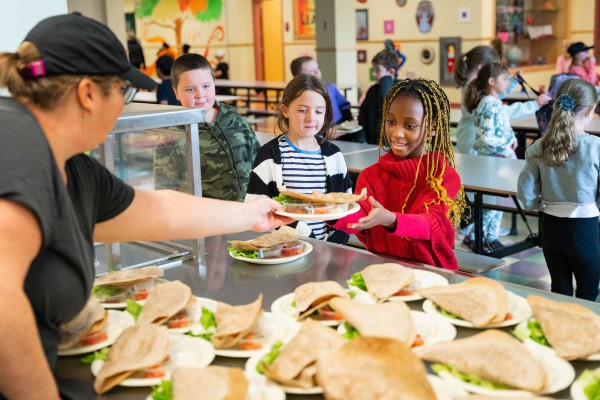
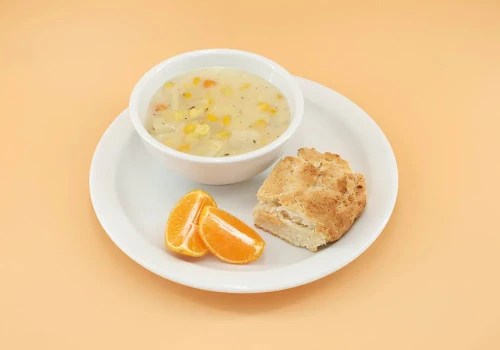
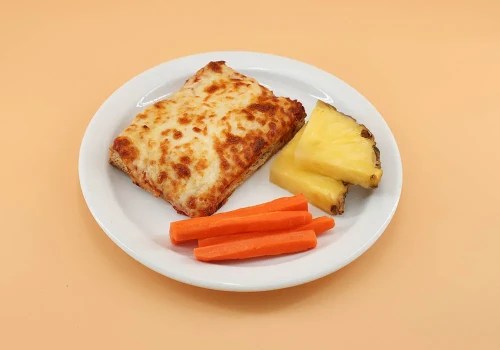
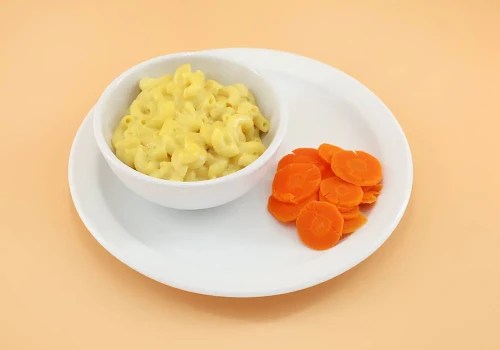
Contrast this with the chaos of lunchtime in most Canadian elementary schools. Some kids don’t bring lunch, some bring a bagged lunch, some have money to buy some food, some (at least here in NS) opt-in to the school lunch – the federally (and provincially) funded program that has been rolled out to most junior schools. What is on the menu? Well here in Nova Scotia, schools serve mini-pizzas, macaroni and cheese, soft shell tacos, and fish cakes with baked beans, among other delights. There is a suggested price of $6.50 per lunch, but any student can eat for free. There is “free” water available to refill water bottles, and there are vending machines with bottles of regular water and juices.
Below: Canadian school lunches look flat and unappetizing in comparison to some of our G7 partners’ meals:
Tacos for lunchSoup or chowder plus biscuit and orange sliceCheese pizza slice with carrots and pineapple piece.Macaroni and cheese with cooked carrots.
Kids eat quickly in a noisy and not very clean room so they can run outside to play. Hired staff monitor the lunch room and funnel the kids into the school yard as soon as they’ve wolfed down their food. Until 2023, according to UNICEF
“Canada was the only G7 country and one of the only OECD countries without a national approach to a school food program. Globally, nearly every country (9 in ten) has a school health and nutrition program and 1 in 2 primary school children receives school meals (388 million children in 161 countries).”
What is right for Europe, and Japan and what is wrong for Canadian children is clear. Here there is little attention paid to proper meals, socializing and respect for food and culture. Campaign 2000’s 2025 Report Card on Child and Family Poverty in Canadanotes that more than 2.4 million children live in food-insecure households; that one in four parents regularly has to skip meals to give food to their kids. At this rate, it will take us 400 years to end child poverty in our country.
$1.1 Billion to watch the FIFA World Cup
Prime Minister Carney is spending $1.1 billion on bringing the FIFA World Cup to Toronto for six games and Vancouver for seven games – that works out to $82 million per game. There is $225 million for “security” –a third of which goes to the ballooning presence (and budget) of RCMP.
The school lunch program costs the feds $1 billion for the first five years, from 2023 until 2028. Starting in 2029, Carney promised program funding of $216.6 million every year. Of course the provinces have to pony up their share—roughly the same amount.
Imagine what could be done to help feed families with $1 billion more.