What organization boasts 3.3 million members but can’t muster anyone to hold a placard on Parliament Hill on Sept. 21, the first day of the fall sitting? Answer: The Canadian Labour Congress.
The fact is the Canadian Labour Congress (the CLC) didn’t muster any forces, nor did their member unions. Nor did the leaders ask their one million union members in Ontario alone to protest the federal government’s promised anti-union legislation. No one organized members from any of the dozens of unions including CUPE, the Steelworkers, the Teamsters, UNIFOR or the Elementary Teachers Federation to protest on the opening day of Parliament.
Protests in Nova Scotia
This is, unfortunately, part of a pattern. Here in Halifax, Labour Day 2026 had few marchers– maybe 50. And the celebration in Peace and Friendship park that followed was not so well attended. Looking across the country, I see the slippage. Yes– unions are bargaining, and pursuing grievances — but workers themselves are distant from their unions. Why?
Some people tell me it’s the COVID legacy – for a couple of years we didn’t socialize except with those relatives or close buddies in our “bubble”. For years we learned online; talked on zoom calls, and had restricted social contact. Weddings and funerals were limited affairs; those who gathered had to wear masks. We were no longer “out there” in public the way we used to be.
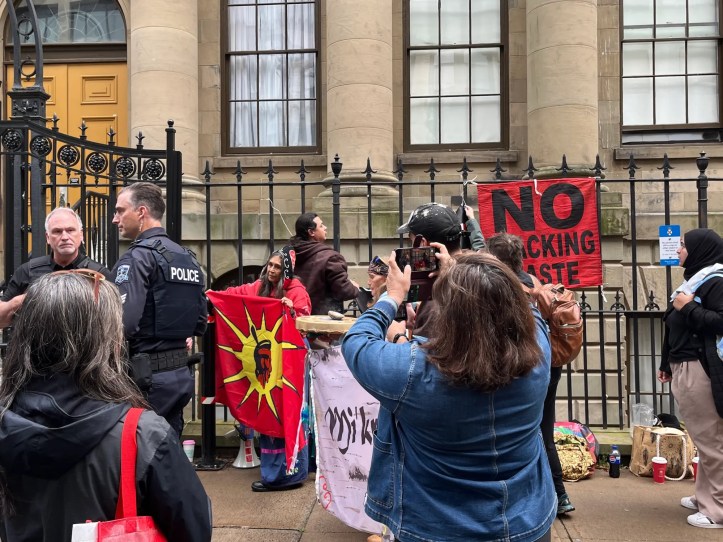
Protest at Province House, Halifax on Sept. 8, 2026 (Credit: Jennifer Henderson)
Since the end of COVID, many unions and labour councils continue to hold union meetings online.
Workshops online are easy to access and cheaper to put on.
Speakers and political big-wigs are willing to give us webinars with Q&A, rather than public speeches with needs for paying for public space and sometimes security.
As for union members—too many are working two jobs or committed to a side hustle that eats up “free” time. There is the dearth of affordable childcare that keeps some members home more. There is the members’ need to help their own families cope with illness, unemployment and precarious living. For years, cuts in care and social programs have meant we need to rely more and more on our families. The state wants to push problems of illness, poverty and homelessness to the individual and their family. We see it all the time. The other day at an appointment at the hospital, I told an aide I needed help to get down some stairs. She asked if I had someone with me, I said no. Then she pointed to the sign that said patients should bring a relative or friend to help them. I asked, what about the sign on the hospital foundation wall which reads, “We’re here to help; we’ve got you.” She tossed her head – well given staff shortages, when you come here bring someone along.
Where is labour– a look at Nova Scotia
By comparison let’s look at the opening day of the spring sitting at NS legislature— six months ago on Mar 3. Thousands of demonstrators protested that day and the next day, clogging streets around Province House. The First Nations-led “Shoulder to Shoulder” protest was composed of a large group of Mi’kmaq land defenders, environmentalists and anti-poverty groups. They protested cuts to grants that affected Indigenous sovereignty and delayed implementing the Calls to Action outlined by the Truth and Reconciliation report. Also protesting were disabled people, and community groups whose grants were also cut by NS’s Tory government.
The Neptune Theatre, the premier theatre in the region, had $150,000 cut by the NS government from its budget
Last winter, Premier Houston had made $130 million in cuts to more than 280 community and cultural organizations in the province. Mi’kmaw, Indigenous, and Black and African Nova Scotian community projects had their funds cut. Among the biggest cuts were $150,000 in operating grants from Atlantic Canada’s premier theatre, the Neptune. The Art Gallery of Nova Scotia’s provincial grant was slashed by tens of thousands; the same applied to scores of non-profit galleries, theatres, community spaces and exhibitions. The government eliminated the $700,000 Publishers Assistance Program and permanently closed six provincially funded museums. The cuts meant hundreds of jobs were on the line in the arts, in publishing, in theatre, in community services. Several unions did join the protests last March, but not in significant numbers. Considering the fact 31% of workers in the province are unionized—that means more than 120,000 Nova Scotians are union members.
With so many other community-based activists demonstrating in March – no one seemed to miss the presence of the unions. But where were they?
At the spring session’s final vote on the cuts, on Mar. 25, more than three dozen women sat in the gallery at the Legislature and sweetly sang “It’s okay to change your mind” over and over again –to delay the passing of the government’s draconian bill. Security ousted the women. Weeks later, the women each received registered letters from the Speaker (Tory Danielle Barkhouse) which prohibited them from entering Province House for the next three months to a year!
The protests had an effect. Within weeks, Houston announced he was going to replace $53 million (of the $130 million) – mostly to Indigenous and African Nova Scotian communities. Just a week before the fall sitting, the 36 women received letters from Barkhouse telling them the ban on them entering Province House had been lifted. Two small victories.
Now six months after the protesting crowds in NS dispersed, we see that on the opening day of the fall sitting of the NS legislature (Sept 8) there was only a small protest of 50 to 100 in front of Province House. They included renters protesting the highest priced rental housing market outside of Vancouver; protesting the opening up of fracking and now uranium mining in the province; the fact the people who live rough are not eligible for the NS enhanced housing benefit since they have no address. As if to offset their terrible record, the Tories introduced two “soft” pieces of labour legislation. One new rule is that overtime pay starts after 44 hours worked in a week (down from 48 hours!). The other bans tip theft. But where are the unions?
Protests in Ottawa. . .
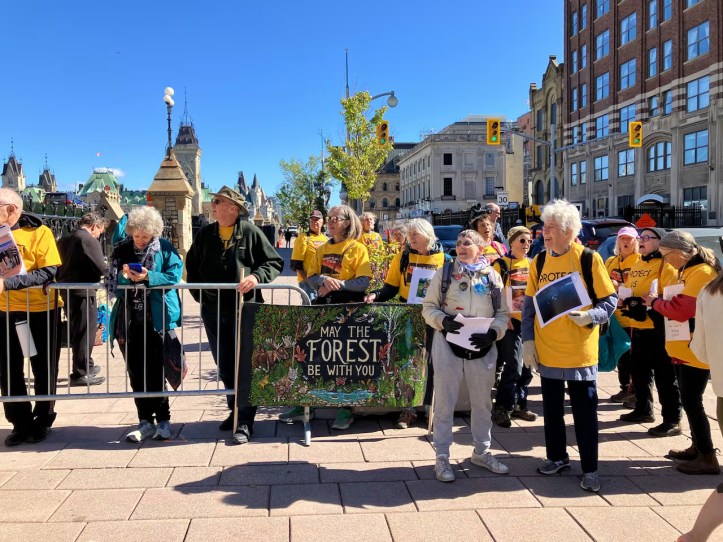
Now we turn to what went on in Ottawa on the opening day of Parliament Tuesday. Not one union protested; indeed the only protesters in front of the House of Commons were retired people from Seniors’ Climate Witness, an umbrella group made up of individuals and activist organizations from across Canada calling for more climate action. Scores of protesters came from BC by train and electric cars, and contingents came from Nova Scotia by ferry, EV and train to stand on Parliament Hill for the opening day. They opposed Alberta’s West Coast Oil Pipeline – a $40 billion project that has now been referred to the prime minister’s Major Projects Office – to push it forward.
Seniors arrive on Parliament Hill as they attempt to deliver climate impact documents to MPs in the House of Commons in Ottawa, on Tuesday, Sept. 22, 2026. (Credit: THE CANADIAN PRESS/Keito Newman)
“extraordinarily broad discretion to end a legal strike based on the minister’s view of the national interest”
One lawyer disparaged the government claims that the new law will create “guardrails” around the use of Section 107. Mark Rowlinson noted,
“The so-called guardrails are frankly nonsense. The legislation gives the minister unfettered power to single-handedly shut down a strike based purely on their opinion. That concentration of power is unprecedented among G7 countries.”
Nina Newington, an activist from Nova Scotia, described the Seniors’ Witness Climate rally in Ottawa on Sept. 19 and 20 as a beautiful but painful experience because everyone in attendance desperately wants more to be done to protect the environment. (Submitted by Nina Newington).
This is a major plank of the anti-labour law – yet the CLC didn’t think to organize any serious opposition to it. Instead CLC President Bea Bruske vowed to oppose the new law in a press release. What was more alarming was her going along with plans Carney has to build the economy – to produce machinery for war. She commented,
“I want to be clear that workers are on Team Canada. We are ready to defend Canadian jobs, to build Canada’s needs, to build our infrastructure, to attract investment and to make this country much more resilient in the face of the Trump trade war. But we cannot have our elbows up against Trump with our hands tied behind our backs at the bargaining table.”
Bruske said it all. She thinks workers are junior partners on Carney’s “Team Canada”—to build up Canada’s industrial capacity. But what that means today is building up defence and war industries, essentially jobs (for the boys) to ensure the bullets, the drones, and the armoured personnel carriers continue to be shipped south to the US to ship to Israel and Ukraine. There is no idea that labour must take a new direction and refuse to support what’s planned for Team Canada. But unions must get better organized to protest Carney’s building a war economy.
Photo at the top: A Green Man gargoyle on the Centre Block, Parliament Hill, Ottawa in 2018.
NOTE: A friend just sent me CUPE’s media release from yesterday; the union says it will defy Bill C-39′s limits on the right to strike if passed.