Thirty-two years ago, in February 1994, a Jewish settler from the US, Baruch Goldstein, walked into the mosque that shared space in the Cave of the Patriarchs in the Palestinian city of Hebron. On that day 800 Muslims were at prayer and Goldstein started shooting. He killed 29 and injured 125 others before being overcome and finally killed by the surviving worshippers.
The world was shocked at the incident, which occurred early in the so-called Oslo Peace Process, and, along with the vastly-expanding increasing Israeli settlements, helped end that ill-fated experiment. People asked “how could this happen?”
Today I am re-publishing a pair of articles I wrote two weeks later for the Saskatoon Star-Phoenix that tried to explain, from my own experience, exactly how that could happen. Five years earlier I had spent a weekend with a settler family from Canada in an illegal and heavily armed settlement called Beit Hadassah. Beit Hadassah in the heart of the Palestinian city of Hebron—steps from the Cave of the Patriarchs.
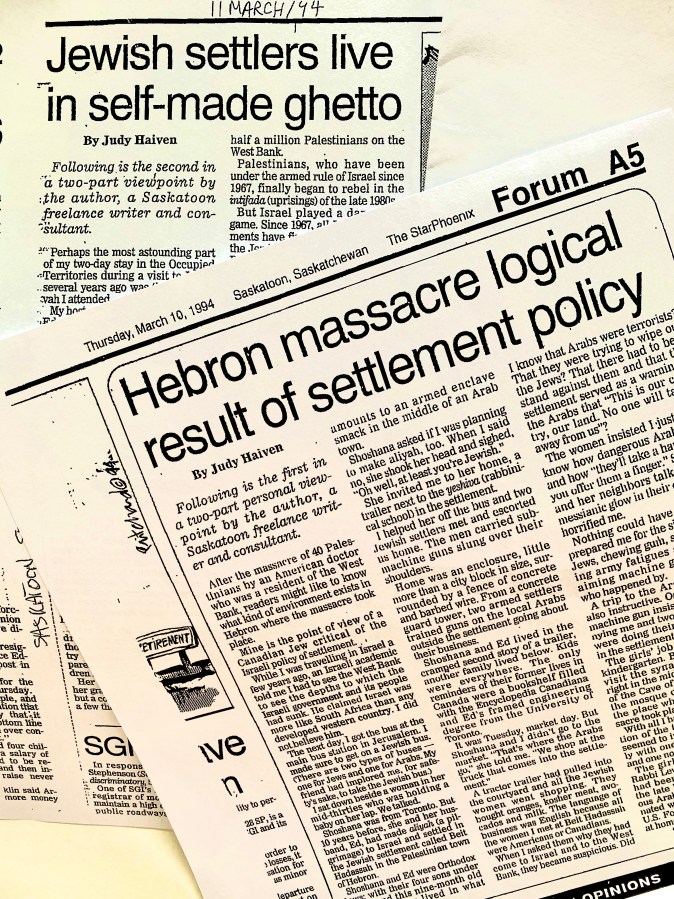
Here are my articles from watching Israel’s occupation of the town where the massacre happened in the West Bank 37 years ago.
Ask yourself, what, if anything, has changed?

Hebron massacre logical result of settlement policy
By Judy Haiven
10 March 1994
(Following is the first in a two-part personal view point by the author, a Saskatoon freelance writer and consultant.– ed.)
After the massacre of 40 Palestinians by an American doctor who was a resident of the West Bank, readers might like to know what kind of environment existsexist.s in Hebron where the massacre took place,
Mine is the point of view of a Canadian Jew critical of the Israeli policy of settlement.
While I was travelling in Israel a few years ago, an Israeli academic told me I had to see the West Bank to see the depths to which the Israeli government and its people had sunk. He claimed Israel was more like South Africa than any developed western country. I did not believe him.
The next day, I got the bus at the main bus station in Jerusalem. I made sure to get on a Jewish bus. (There are two types of buses – one for Jews and one for Arabs). My friend had implored me, for safety’s sake, to take the Jewish bus.
I sat down beside a woman in her mid-thirties who was holding a baby on her lap. We talked.
Shoshana was from Toronto. But 10 years before, she and her husband, Ed, had made aliyah (a pilgrimage) to Israel and settled in the Jewish settlement called Beit Hadassah in the Palestinian town of Hebron.
Shoshana and Ed were Orthodox Jews: with their four sons under age 10 and this nine-month old baby girl, they lived in what amounts to an armed enclave smack in the middle of an Arab town.
Shoshana asked if l was planning to make aliyah, too. When l said no, she shook her head and sighed, “Oh well, at least you’re Jewish.”
She invited me to her home, a trailer next to the yeshiva [rabbinical school] in the settlement.
I helped her off the bus and two Jewish settlers met and escorted us home. The men carried sub-machine guns slung over their shoulders.
Home was an enclosure, little more than a city block in size, surrounded by a fence of concrete and barbed wire. From a concrete guard tower, two armed settlers trained guns on the local Arabs outside the settlement going about their business.
Shoshana and Ed lived in the cramped second story of a trailer; another family lived below. Kids were everywhere. The only reminders of their former lives in Canada were a bookshelf filled with the Encyclopedia Canadiana and Ed’s framed engineering degree from the University of Toronto.
It was Tuesday, market day. But Shoshana and l didn’t go to market. “That’s where the Arabs go,” she told me, ”We shop at truck that comes into the settlement.”
A tractor trailer had pulled into the courtyard and all the Jewish women went shopping. They bought oranges, kosher meat, avocadoes and milk. The language of business was English because all the women I met at Beit Hadassah were Americans or Canadians.·
When I asked them why they had come to lsrael and to the West Bank, they became suspicious. Did I know that Arabs were terrorists? That they were trying to wipe out the Jews? That there had to be a stand against them and that this settlement served as a warning to the Arabs that ”This is our country, our land. No one will take it away from us'”?
The women insisted I just didn’t know how dangerous Arabs were and how “they’ll take a hand when you offer them a finger.” Shoshana and her neighbours talked with a messianic glow in their eyes which horrified me. Nothing could have adequately prepared me for the sight of fellow Jews, chewing gum, smiling, wearing army fatigues and casually aiming machine guns at Arabs who happened by.
A trip to the Arab market was also instructive. One fellow with a machine gun insisted on accompanying me and two Israeli girls who were doing their military service in the settlement. The girls’ job was to operate a kindergarten. Both insisted that I visit the synagogue which was right in the middle of Hebron, part of the Cave of the Patriarchs with the mosque on the other side – the place where the recent massacre took place.
With all I had seen, the juxtaposition of the two places of worship seemed to invite conflict, especially with one group heavily armed and one not.
The girls wanted me to meet Rabbi Levinger, an American who had been personally trained by the late Meir Kahane -·a notorious Arab hater and racist, assassinated while on a trip home to the US. Fortunately, the rabbi wasn’t at home.
And here is my second article, published the next day.
Jewish Settlers Live in Self-Made Ghetto
By Judy Haiven
11 March 1994
Perhaps the most astounding part of my two-day stay in the Occupied Territories during my visit to Israel several years ago was the Bar Mitzvah I attended.
My hostess Shoshana, her husband Ed, their three kids and I went to Kiryat Arba, a spanking new Jewish settlement a few kilometres down the road from Hebron.
It was an Orthodox ceremony. The men sat in one room, the women in another. The bar mitzvah boy had been born in the U.S., as had his parents. The boy’s grandmother had come over from the U.S. to attend.
The grandmother, an attractive 60-year-old, wore a stylish wool suit, stockings and high heels. But she and her husband looked extremely ill at ease. In contrast, in the Orthodox of modesty, the young mothers at the celebration – also originally from the U.S. – wore kerchiefs over their heads, long sleeves, no makeup, shapeless dresses, stockings and flat shoes.
I immediately understood the grandmother’s mortification. In three or four generations, her family had emerged from and returned to the shtetl (Jewish village in eastern Europe).
In the U.S., she had raised her children in a modern way and had thought the ghettoes of the old country had been left behind when her parents emigrated. Not so. Her children had created a new ghetto.
Her children’s ghetto and that of her grandson was not Israel proper but a concrete bunker community of a few thousand Jews in the midst of half a million Palestinians on the West Bank.
Palestinians, who have been under the armed rule of lsrael since 1967, finally began to rebel in the intifada (uprisings) of the late 1980s.
But Israel played a dangerous game. Since 1967, all Israeli governments have financed and increased the Jewish settlements on the West Bank in order to appease right-wing Jewish extremists who insist all of greater Israel belongs only to the Jews.
The government, by annexing the Golan Heights, the West Bank and Gaza in all but name, wanted to assure Israelis that the seizure of these areas was irreversible.
The Israeli government also, albeit more covertly, originally funded Hamas,.an Islamic fundamentalist group which repudiates the moderate line of the Palestine Liberation Organization and rejects any form of peace talks with the Israelis.
Now, the Israeli government is in a quandary. It says it wants peace. But its predecessors allowed the permanent construction of scores of Jewish settlements in the Occupied Territories. Hundreds of thousands of Jewish settlers now own land there.
Baruch Goldstein not only carried a submachine gun into the Cave of the Patriarchs that day last month when he killed 29 Arab worshippers, he carried the full weight of 25-years of Israeli occupation of the West Bank and the settlements, if not the intent of majority of Jewish West Bank settlers.
Another Israeli extremist could easily be waiting to do this again. Israel has created a monster. Perhaps the one good thing to come out of this dreadful massacre is the fact that more and more Israelis and people around the world will see the settlements not as benign communities but poisonous impediments to a lasting peace with the Palestinians.
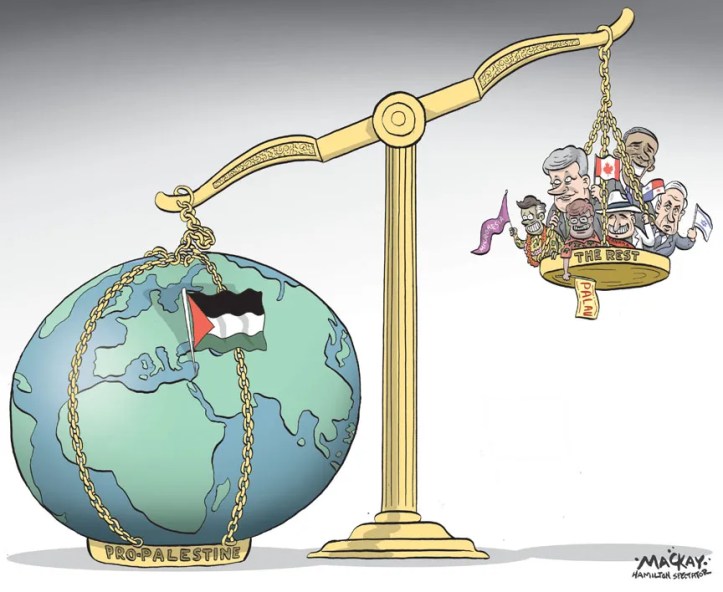
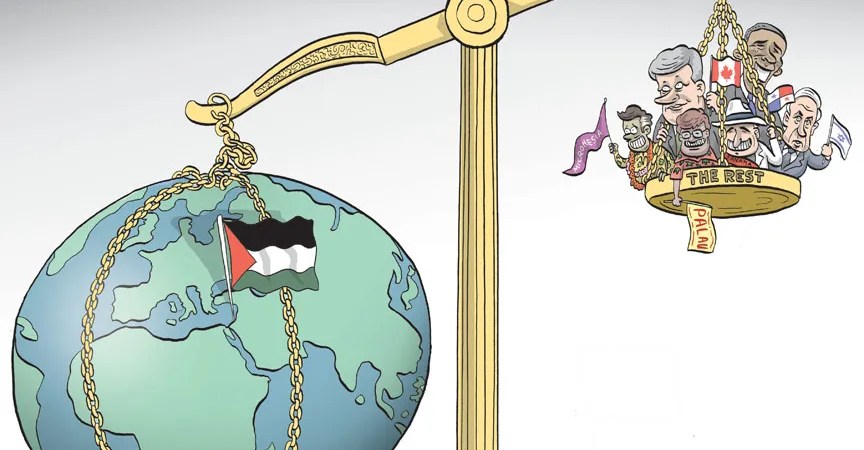
Cartoon at the top and below by Graeme MacKay (Canadian), in the Hamilton Spectator, Dec. 1, 2012. What’s changed in the 14 years since publication? See more here