My mother, a Jew born in Toronto in 1920, was a very good student. She liked school; she fit in, studied hard and graduated from Harbord Collegiate in 1938.
All three of her older sisters had graduated from university; one was a doctor and research scientist; one was a high school teacher and one was a crafts person who worked with four other potters to form a first artisan coop, a Toronto pottery studio in the 1960s called The Five Potters.
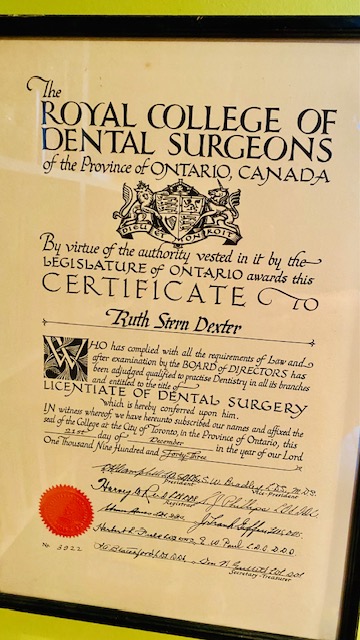
My mother, the youngest daughter, decided to become a dentist.
Her grades were high and she passed the manual skills test that all dental school applicants had to pass. At the time there were two quotas for restricting who was accepted into the professional schools at most Canadian universities. At the University of Toronto, there was a quota on the number of Jews allowed into the dental (or medical) program; and there was also a quota on the number of women admitted.
My mother entered University of Toronto’s dental school in September 1938.
At the time, she thought little of the quotas – after all there had been quotas levelled on Jews and women for at least the previous 15 years at U of T (ever since a post-World War I panic about Jews taking up too many student spaces). Given my mother’s academic skills, she managed to jump the hurdles and graduate near the top of the class of 50 men and three women.
No one formally said the quota for Jews was antisemitic, it was just the way it was. As one writer put it, “Antisemitism was built into the very structure of medical [or dental] training.” It was also true that at some Canadian universities, Jews and other minority candidates used to have to earn higher marks than other Canadians just to enter dental (or medical) school.
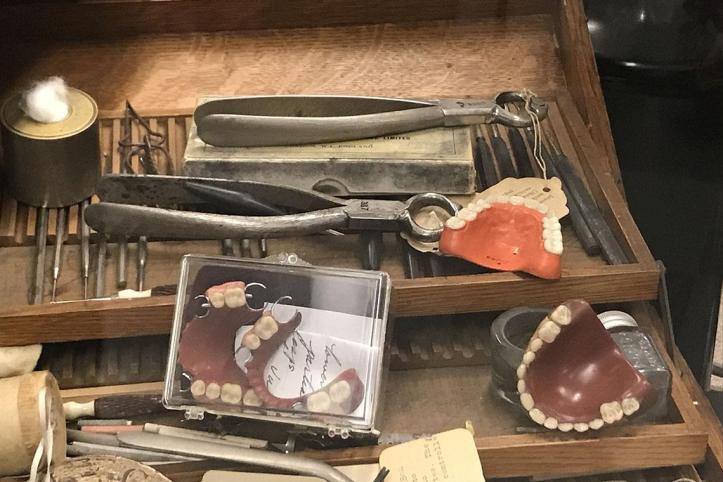
In 1943, my mother graduated as a Doctor of Dental Surgery, DDS. She opened a private dental practice on Toronto’s Bloor St. West. In the 1960s, she worked part-time as an emergency dentist at Women’s College Hospital, and worked as a dentist in three downtown Toronto public schools. Before retiring, she taught dental hygienists at George Brown College.
My uncle Ed was not so lucky. My father’s brother got an MSc in Physics from University of Toronto in 1941. He too was a good student and wanted to go on to study for a doctorate in theoretical physics. But Jews were not allowed to enroll in PhD programs in physics, some sciences or graduate degrees in engineering. Jews were considered possible security risks and the government of the day disallowed Jewish students to get involved in research which –even tangentially– had to do with national security.
Uncle Ed ended up teaching math and physics at a Toronto high school. It was a job but not the career he wanted.
Both my mother and Uncle Ed endured antisemitism. They endured limits to their careers, and their earnings over a lifetime.
Both probably did not consider that things would change. They were “glad” to get university degrees, and my mother especially felt proud being a working, well-paid, professional woman at a time when fewer than 24% of Canadian women worked outside the home.
Why am I reminiscing about the difficulties faced by my mother and my uncle in the 1940s? Because they are very real evidence of the systemic discrimination against Jews in academe and the professions that lasted until the early 1960s in Canada. But I also want to stress that Canadian Jews no longer face this kind of systemic discrimination. However, other groups do face it.
Today, Jews no longer are turned away from professions, or university programs. Indeed, Jews are represented there in much greater proportion than in the population as a whole. There are no more quotas. No more systemic discrimination. For Jews.
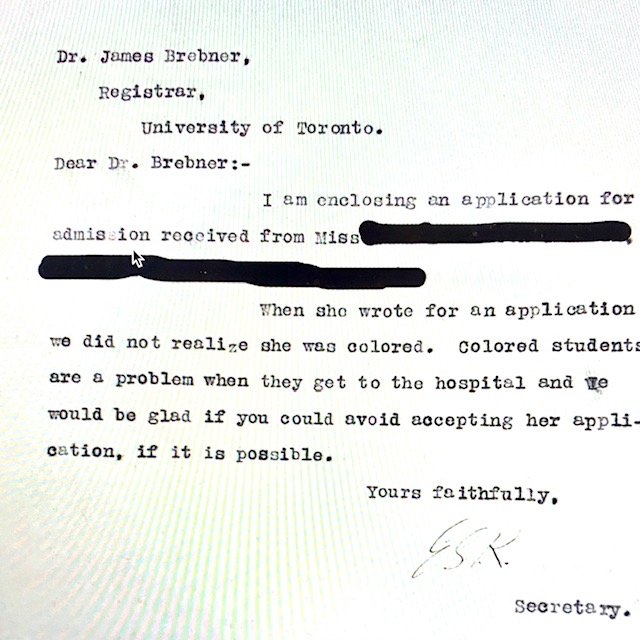
University of Toronto Archives. Faculty of Medicine. A1979-0023/005 (32)
Indeed, David Koffman, the J. Richard Shiff Chair for the Study of Canadian Jewry at York University, summed up the current situation for Canadian Jews three years ago in his book No Better Home: Jews, Canada, and the Sense of Belonging “Canada may now very well be the safest, most socially welcoming, economically secure, and possibly most religiously tolerant home for the Jews than any other diaspora country, past or present.”
Yet to listen to plaintive remonstrances of the Troika of Jewish-Canadian establishment organizations, the Centre for Israel and Jewish Affairs (CIJA,) B’nai Brith Canada (BBC) and Friends of the Simon Wiesenthal Canada (FSWC), you would think that we Jews had not only failed to emerge from the dark days of the 1940s but rather receded further into a black hole of racism.
Systemic discrimination and exclusion are still alive in Canada. Not for Jews, certainly, but for many others. We don’t use quotas anymore, but the discrimination for others, including Black people, is real.
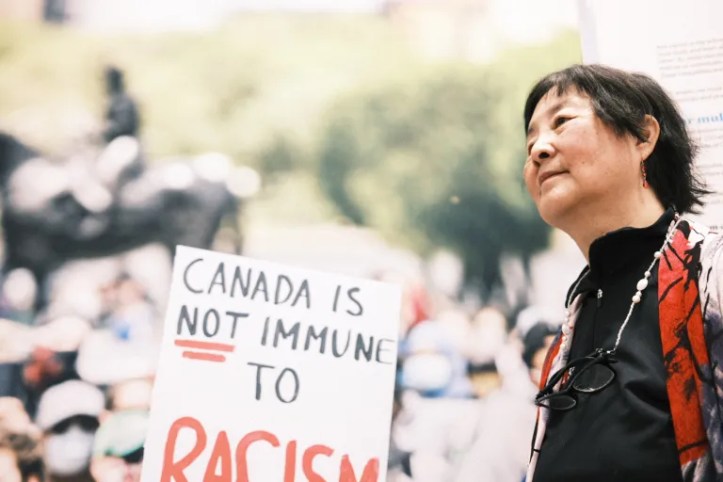
Photo: Ontario Science Centre (which is about to be destroyed by Ford government)
Let’s compare lives and life chances of two minorities, Jews and Black people. The facts are these:
- On par with other Canadians, more than 29% of Black Canadians have an undergraduate university degree. However more than 80% of Canadian Jews have a bachelor’s degree.
- In 2020-21, 9% of prisoners in federal prisons were Black; Black people accounted for just 4% of Canada’s total population.
- I could only find one figure about Jews in prison. In the year 2016-17, according to Correctional Service Canada, Jews were under-represented at 0.8% (less than one percent) in the federal prison population – or 177 offenders.
- University of Toronto sociologist Robert Brym writes, “Dividing Canada’s population into religious groups, one finds that Jews have the highest annual income and the lowest poverty rate, while Muslims have the lowest annual income and the highest poverty rate.”
- Though some of the income gap could be attributable to years living in Canada, Author Brym notes that even if you try to level the playing field and look only at Jews and Muslims born in Canada, the disparity in annual earnings is still huge. One commercial employment site in 2023 noted the median salary for Jews was $68,479 per year. The median salary for Black Canadians was $35,008 The median earnings for non-racialized Canadians was $42,374.
Also, Black Canadians earn 75.6 cents for every dollar a non-racialized worker earns.
- Even as far back as 1991, figures revealed that 9.3% of Canadian doctors and surgeons were Jewish, as were more 4.5% of lawyers. At that time, Jews represented 1.3% of the total Canadian population Today Jews are just 1% of Canada’s population but it’s likely their proportion in professional jobs has increased since ’91. By comparison, Black lawyers make up 3.2% of lawyers in Ontario. Black doctors and surgeons account for 2.3% of all medical doctors in Canada.
- Black people are still vastly under-represented in some of the professional schools. Dr Chika Stacy Oriuwa, noted that in 2016, she was the only Black student out of 259 students in her first year medical class at the University of Toronto’s Temerty Faculty of Medicine.
- Over the last five decades, every year Jews have generally made up around 20% of Toronto’s medical school student admissions
- At the Temerty Faculty of Medicine, a 2022 report showed 19.3% of medical school professors were Jewish, and only 2.3% were Black.
- The situation for Black medical students has slowly improved. In 2024, 24 were accepted as medical students, the largest cohort of Black medical students in Canadian history. That number is 7.4% of the 323 students accepted as medical students.
EDI the ‘root cause of antisemitism on campus’??
And yet, some Jewish spokespersons and institutional organizations in the US and Canada attack programs promoting equity, diversity and inclusion (EDI) as inherently antisemitic. A year ago, Alan Dershowitz wrote in the top US political website The Hill, “Campus antisemitism has become systemic due to ‘diversity, equity and inclusion’.” Bill Ackman, a major funder of Harvard University, who was instrumental in the attack on Harvard President Claudine Gay, complained that EDI was the root cause of antisemitism on campus. In May 2024, Simon Fraser University professor Lilach Marom summed up the Jewish criticism of EDI:
“I’m worried about the new antisemitism that emerges at the intersection of anti-racism and settler-colonial discourses,” she said. “Both those discourses are insufficient and incomplete to understand Jewishness, the Jewish condition or the situation in Israel-Palestine.… They create this forced binary between Jewish people as the embodiment of white privilege and colonial oppression, and Palestinians as racialized and indigenous. I think this binary is not only inaccurate, it also feeds into new forms of antisemitism.”
In August 2023, the Jerusalem Post cited U of T medical school professor Ayelet Kuper:
“Dr. Ayelet Kuper, functioning as the senior adviser on antisemitism at the school, referred to ‘curricular silencing,’ wherein antisemitism is ‘largely ignored’ in the school’s DEI [diversity, equity and inclusion] courses, despite a mandate to include the subject as issued by that university’s antisemitism working group.”
To hear these complaints one would think that the current conditions for Jewish and Black Canadians were exactly opposite to what they really are.
“Jews are three times more likely than non-Jews to think that Jews often experience discrimination.”
Dr Robert Brym, Sociologist a University of Toronto
In fact a key to the Jewish complaints about EDI and anti-discrimination initatives are linked not to bigotry against Jews as Jews, but to criticism of Israel, which is an entirely different thing. As sociologist Brym writes, “Jews are three times more likely than non-Jews to think that Jews often experience discrimination.”
Canada’s “official” Jews insist they are discriminated against and hated because of their support for Israel. If any other group in our society supported the murder of more than 43,000 people in Gaza, argued the maiming of more than 100,000 Palestinians, and the amputations of more than 3,000 children, the destruction of millions of homes, were totally legitimate and necessary to “root out” Hamas, the pro-Israel supporters would be criticized and denounced.
Does anyone seriously believe that Canada’s “official” Jews face discrimination, bullying and harassment because of being Jews? Or is it really about their blind support for Israel?
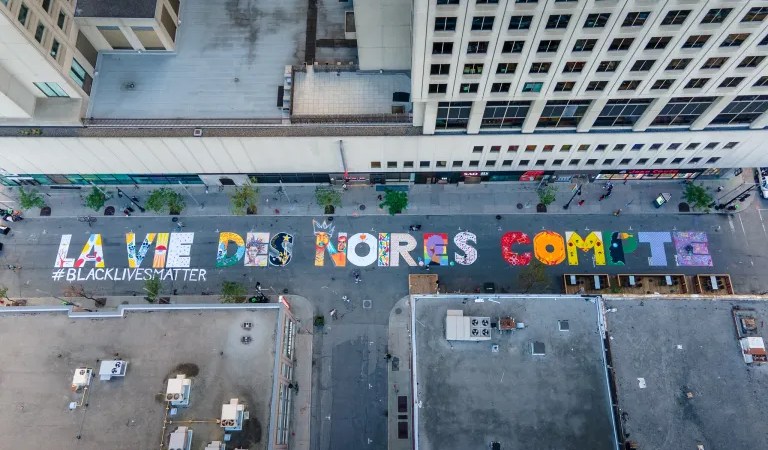
Image at the top: “Public art plays an important role in making both rights abuses and joyous celebration visible. Black Lives Matter – Montreal created this huge, colourful street art project on rue Sainte‐Catherine in downtown Montréal.”
Photo: Lëa-Kim Châteauneuf
 Another ruined dinner party...
Thank you for this and all of your insights, Judy. I regularly share your blog on Facebook. Diane and I hope you are all well. Don
Please visit my website: and consider ordering a book. Don Hayward – Author https://danddhayward.ca/
LikeLike
thanks and I’ll stay in touch!! regards j
LikeLike
This is everything! Thank you. I NEEDED to read your article after reading this shite:
https://nationalpost.com/opinion/mark-dsouza-the-soft-the-bigotry-of-tmus-low-expectations?taid=67219db17f406c0001d25d85&utm_campaign=trueanthem&utm_medium=social&utm_source=twitter&s=09
LikeLike
I agree with you about the National Post horror show. And now it “publishes” the “new” in Halifax !!
LikeLike