(You can see Part I here)
In Canada, 120,000 to 138,000 people work in assembly and parts manufacturing in the automobile industry. Women make up only 23% of the auto assembly work force, and from 17-33% of jobs in parts.
28,000 Canadians work in the lumber industry. Just over 17% are women.
More than 1.6 million Canadians work in the construction industry. Only 13.6% are women. Why are there so few women in these industries?
Just over 81,000 Canadians draw a paycheque from working for the 600 or so private firms that manufacture weapons, armaments, bombs, armoured vehicles, and ammunition. Divided into three groups: there are a) STEM professions such as engineers, scientists and technologists; b) production workers and c) corporate functionaries such as managers and administrators.
In total more than 73% of all the jobs in the defence manufacturing industry currently go to men, and only 27% (about 22,000 jobs) go to women.
Women drastically under-represented
In 2022, statistics for Canada’s defence industry show that in the three categories, women were drastically under-represented:
| Percentage of women working | Percentage of men working | Total workforce, male and female | |
| STEM workers | 17% | 83% | 31% |
| Production workers | 26% | 74% | 38% |
| Corporate/office workers | 38% | 62% | 31% |
Adapted from Female Employees Share of Occupation Types, here
Although the Carney government wants to boost private sector defence jobs – if current trends continue, only 17% of the quality, high paying jobs in defence such as in STEM occupations –have gone to women. What’s worse is that the PM announced the creation of the Defence Investment Agency (DIA) . This business-friendly boondoggle is supposed to expand the production of weapons and other armaments and basically sell them to the Canadian Armed Forces – estimates are that 70% of the production will stay in Canada. In 2022, for example, 63% of Canadian defence industry exports went to the US — less than one percent went to each of Australia and New Zealand and a paltry 5% went to the UK. There has been criticism of our government using this as a “back door” to sell parts, weapons, and armoured vehicles to Israel for its genocide in Gaza and the West Bank. Currently the government is not allowed to sell weapons to Israel. But it continues to do so through some loopholes. In April 2025, PM Carney revealed for the first time that
“… goods for Israel’s Iron Dome missile defence system are exempt from the Liberal government’s pause on military exports to Israel.”
The government wants to shore up SMBs (Small and Medium Businesses) in the war industry by spending $357 million early in 2026 in regional defence investments across Canada and giving more than $4 billion through the Investment Initiative program. Our government will make loans and venture capital available to SMB firms to “scale up” Canadian defence capability. And to sell armaments and war toys to our “friendly” allies” in Europe for example. But they are producing more and more weapons too.
As Dr Philippe Lagassé, a professor of international affairs at Carleton University and a specialist on Canada’s defence procurement system notes, France is now the world’s second largest arms exporter (next to the US). France sells arms to various dictatorships and other brutal regimes. The other option, as Lagassé put it somewhat provocatively, “let’s say you don’t want to be full France. Let’s say you want to be Sweden.” That is also a problem, as the Nordic country sells military equipment to the United Arab Emirates (UAE), Saudi Arabia, Thailand, Pakistan – some with questionable to abysmal human rights records.
In the federal government’s report Canada’s Defence Industrial Strategy, the government says that NATO has earmarked 10 out of 12 critical raw materials found in Canada as critical to defence. And that the G7 Critical Mineral Production Alliance insists that Canada has to stockpile critical minerals including nickel, cobalt, zinc, aluminum, potash and more niche minerals such as indium, graphite, germanium, gallium and uranium.
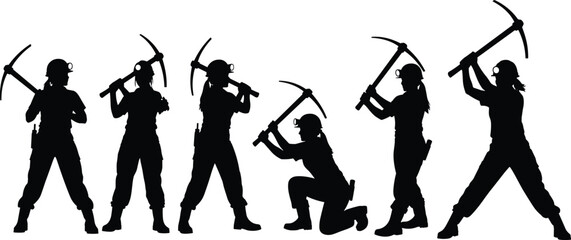
Critical Minerals Mining– jobs for women?
Carney has already put into place a Critical Minerals Plan that invests $116 billion in mining and infrastructure. Here are its three major planks,
- Canada Nickel’s Crawford Project in Timmins, Ont. will see “responsible mining” of nickel for batteries and steel. The government insists, “The project will attract $5 billion in investment and create thousands of new careers, securing Canada’s place at the forefront of the clean economy.”
- Nouveau Monde Graphite’s Matawinie Mine – Saint-Michel-des-Saints, Qué. will mine graphite for supply chains. The promise is “It will create over one thousand new careers and draw $1.8 billion in investment.”
- Northcliff Resources’ Sisson Mine in Sisson Brook, New Brunswick will produce tungsten – a critical mineral in steel production, defence, and industrial uses “while creating hundreds of new careers.”
Government papers draw attention to hiring and training first nations’ peoples and youth but nothing about jobs for women. Reminds me of now dust-gathering 2014 tome, Now or Never: an urgent call to action for Nova Scotia a report by a blue-ribbon provincial committee about shepherding NS to enter the future. In 243-pages that touched briefly on youth employment, and focused on immigration and increasing tourism—there was not a single mention of women.
Critics stressed at the time that the Now or Never Report did not pay attention to income inequality, access to housing and quality jobs, transportation or the well-being or health of Nova Scotians. The report was predicated on building and expanding. That is more or less Carney’s plan today which calls for the creation of 125,000 new jobs to build weapons and a pro-war economy.
Women at work in war industries
There are two considerations when it comes to women and work in weapons manufacturing. First, do women (or some men) want to work in industries that produce weapons of destruction, that further wars and genocides – such as Israel’s genocide of Palestinians in Gaza? A recent research report by a coalition of anti-war groups called Arms Embargo Now, found Canadian weapons manufacturers exported 47 shipments of military-related components to Israel between October 2023 and July 2025. Yet Canada is a signatory to the Geneva Conventions And Arms Trade Treaty that obligates us to prevent genocide.
But from October 2023 to June 2025, Canada has sent more 421,000 bullets to Israel, including 175,000 sent in April 2025. Canada has transported 391 shipments of Canadian-made bullets, military equipment, weapons’ and aircraft parts to Israel. We in Canada are directly and indirectly responsible for the murders of more than 75,000 Gazan civilians – including 50,000 killed or injured children. A joint report by Oxfam and Action on Armed Violence in October 2024 found the Israeli military had killed more women and children in Gaza than in any other conflict around the world in the past two decades. Do women want to work in the arms industry – does anyone?
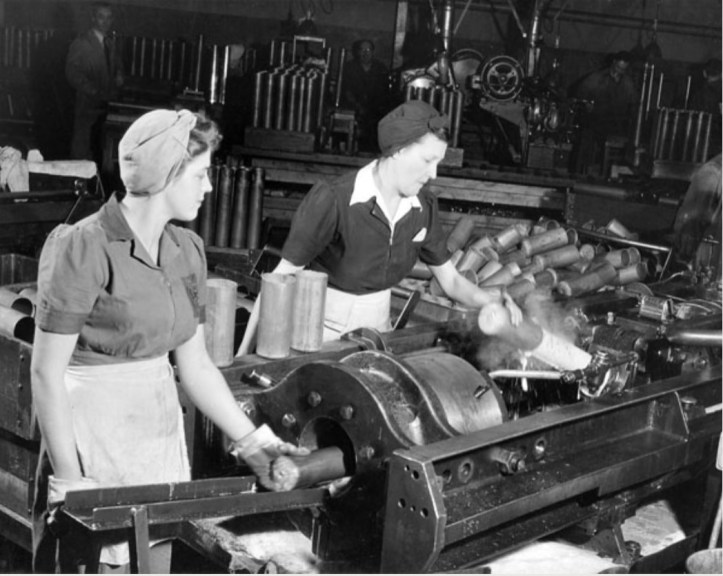
A second consideration about women and work is that manufacturing arms amounts to jobs for the boys. Engineering, assembly, transportation, construction, mining – these are all heavily male-dominated fields and workplaces. PM Carney and his buddies are building a vast war industry in Canada that promises to be very lucrative for the 600 manufacturers.
But what about women and work? Was it always thus?
- 60% of minimum wage earners are women—57% in Nova Scotia
- 56% of women in Nova Scotia earn less than $20 an hour
- 60% of precariously employed professionals are women; precarious work includes part-time, contract, seasonal or other types of precarious jobs
- whether in full or part time work, women earn $0.89 an hour to every dollar men earn
- when employed full-time, women still earn on average $0.90 an hour to every dollar men earn. The statistics are much worse for women who are racialized, Indigenous or disabled.
What woman still wants to work in the CAF?
What will three new mine sites offer women workers? What jobs will women have in bullet and weapons manufacturing? For the last 30 years women have made up fewer than 25% of manufacturing jobs. Will that change with an increased arms manufacturing, and an expansion of the Canadian military because that is also part of the plan. In the last decade there have been more than five major reports on sexism, sexual assault, and rape against thousands of women in the Canadian Armed Forces (CAF) including,
- Women’s Veterans’ Experience, a Standing Committee on Veterans’ Affairs, ACVA Report (2024)
- The Arbour Report (2022)
- Report of the Standing Committee of National Defence (Stats Canada 2019)
- Sexual Misconduct in the Canadian Armed Forces (Stats Canada 2016)
- The Deschamps Report: External Review into Sexual Misconduct and Sexual Harassment 2015)
There have also been a number of class action suits by hundreds of military women who were harassed and/or raped while serving in the Canadian military. In 2021, more than a dozen senior officers (about half of the 48 senior-most officers in the entire military) – were charged with
“sexual assault, questionable behaviours, or conduct deficiencies of a sexual nature (the latter formulation has recently replaced the term ‘sexual misconduct’ in the CAF)”.
The reports note that more than one quarter of women in the Canadian Armed Forces have been sexually assaulted at least once during their careers. In 2022 for instance, 34% of women in the Regular Forces experienced sexualized or discriminatory behaviour by coworkers.
Stop: Read that paragraph again
Stop: Read that paragraph again if you missed the absolutely unbelievable amount of abuse of women. Something tells me that women in the defence industry and in the military are not welcome.
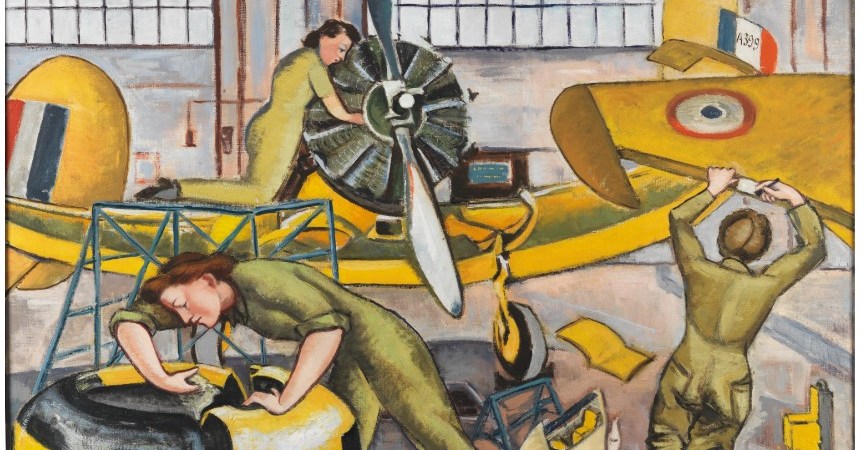
Image at the top: Maintenance Jobs in the Hangar, 1945 by Paraskeva Clark – Beaverbrook Collection of War Art – Canadian War Museum, Ottawa. Watch Who is Paraskeva Clark? a 9 minute film here.
 Another ruined dinner party...
[…] money is there but it is used to prop up the military, provide tens of thousands of new jobs in the war industry for the boys and be a bit player in ongoing wars against civilians. Journalist Nora Loreto […]
LikeLike