
OK, let’s have a look at the outlook for jobs and more importantly job creation that PM Carney has recently announced. The government will spend more than $116 billion in its Major Projects Office – MPO (a riff on PMO)? According to Carney, it will be “transformational” and see Canada rise to its “full potential as an energy superpower.” Of course the idea is for the MPO to attract investment for about megaprojects that will get the country humming, and perhaps less dependent on the US. With the caveat that governments (and corporations) often brag about promises for jobs creation in new megaprojects that are often not fulfilled, here’s what’s really happening with the PM’s plan.
The billions of dollars are earmarked to shepherd nation-building projects through the “red tape” of approvals, building the projects and pushing them ahead. The Liberal government boasts these megaprojects will boost employment and even careers for tens of thousands over the next five years. How true is this?
Seven of the projects include the tungsten Sisson Mine in Stanley, NB; the Crawford Nickel Project in Timmins, Ont; the Iqaluit hydro project; the Matawinie graphite mine in Quebec; Northwest critical conservation corridor in northwest BC and Yukon; KSI Lisims liquified Natural Gas in BC.
Women can just stay home
The not-so-fine print is that these projects are mostly going to yield jobs for the boys—and not so many of them over the coming years. Women can just stay home. I mean that – for every project, at every minesite—virtually all the women employed, will end up doing housekeeping, kitchen duties and clerical work for the mining or construction company. In fact, 55% of women in the energy sector work in companies’ business offices and in finance. What’s more, women equally as qualified as men in the sector’s trades careers earn about 20% less than men. This is despite the fact that 41% of women in the sector have a Bachelor’s degree or higher, compared with only 22% of men.
“We oppose war and we oppose supporting the construction of weaponry.”
Wolasotq Grand Chief Ron Tremblay
Let’s take a look at the Vancouver-based Northcliff Resources’ Sisson tungsten and molybdenum open pit mine in Stanley, NB. The US Department of Defence gave Sisson $20 million and the Canadian government ponied up $8.2 million to develop the mine 60 km north of Fredericton, to dig for critical minerals like tungsten and molybdenum. Tungsten goes into the manufacture of antitank shells and armour-piercing ammunition. Molybdenum is used as an alloy to make armoured vehicle, missiles and aircraft. However Indigenous elders such as Wolasotq Grand Chief Ron Tremblay don’t like the project; on behalf of his band, he refused to contribute to the “continuum of genocide” in the Gaza Strip and the West Bank. Tremblay said,
“We oppose war and we oppose supporting the construction of weaponry.”
He also noted how ironic it is that Canada is trying to divorce itself from the US, and forge a different path – yet welcomes the ties to the US defence industry. Tremblay quipped,
“That’s like getting back together with your abusive spouse.”
How many jobs are we talking about for the Sisson mine? 500 jobs in construction, and 300 jobs over the forecast 27-year life of the mine. What percentage of those jobs will be filled by women? And what kind of work and pay will be on offer?
Another project is the Crawford Nickel Project in Timmins, Ont. A government backgrounder promises it will deliver 4,000 “new careers.” Miners will dig 240,000 tonnes of nickel and magnetite each day from the open pit mine, and 120,000 tonnes will be milled (crushed for processing elsewhere, maybe in the US). These minerals will be used to produce batteries and steel over the mine’s 40-year lifespan.

Canada Nickel’s impact report confirms that priority employment for women and Indigenous people amount to afterthoughts:
“Other decisions, such as workforce hiring practices, will be made at a later date. Canada Nickel is committed to hiring first from local communities and the region, to encourage employment of Indigenous peoples, local youth, women, and under-represented populations, and to offering training opportunities to local residents.”
Typically women are not hired for jobs such as clearing the land, building roads, and building two processing plants—all required at the outset by Canada Nickel.
Another project is the Nouveau Monde Graphite’s Matawinie site in Saint-Michel-des-Saints, 120 north of Montréal. Metawinie will mine106,000 tonnes per year of graphite concentrate over the next 25 years. This isn’t to churn out school pencils but to make electric vehicles, batteries and for “defence” purposes. Graphite is used to make components for firearms, artillery, missiles and submarines. The mine will excavate tungsten, copper, lithium, nickel and cobalt so that “global allies can benefit” from Canada’s critical minerals production. Matawinie will also build a battery manufacturing plant near Montreal.
Lip service about jobs
Again no attention paid to jobs for women, or Indigenous peoples or their land rights in the geographic area. Actually, some of these projects play lip service to the employment needs of women and Indigenous peoples,but we know that over the long run, plans and considerations that benefit any group (other than mine owners and suppliers) are pretty well ignored.
Yet women in mining are usually hired as housekeepers or cleaners in the “man camps” or facilities where the miners stay. The man camps also promote violence against Indigenous women. The 2019 National Inquiry into Missing and Murdered Indigenous Women and Girls (MMIWG) reported
“Work camps, or ‘man camps,’ associated with the resource extraction industry are implicated in higher rates of violence against Indigenous women at the camps and in the neighbouring communities. This increased rate of violence is largely the result of the migration into the camps of mostly non-Indigenous young men with high salaries and little to no stake in the host Indigenous community.”
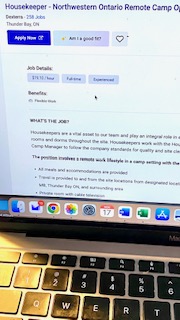
These two job ads below listed on Indeed! are from Dexterra, a major facilities’ management company operating at many remote energy/mining sites in Canada. As you can see, cleaners or housekeepers currently earn $19 to $24 an hour. Typically male workers who operate computer keys to control a drill earn at least $44 an hour. Women make up only 16% of full time jobs in the mining sector. By comparison, across all occupational sectors in Canada, women are 48% of the workforce.
sorry about the blurriness:

The construction industry is similar. Women make up only 13.6% of all jobs in construction (including residential, commercial, mines, and megaprojects). 80% of women in the trades are certified, but they are certified as cooks, bakers and hair stylists that are lower paying occupations. Studies show that eight years after certification, women typically earn $27,000-$41,000 a year, while men in trades they traditionally dominate earn from $36,000 to $51,000 a year.
So Carney’s vision of a future is little more than seeing Canadian workers as hewers of wood and drawers of water – something men with more brawn, beckoned by good wages and less concerned about safety– are willing to do. But the government’s megaproject vision will not move women, Indigenous people forward significantly at all.
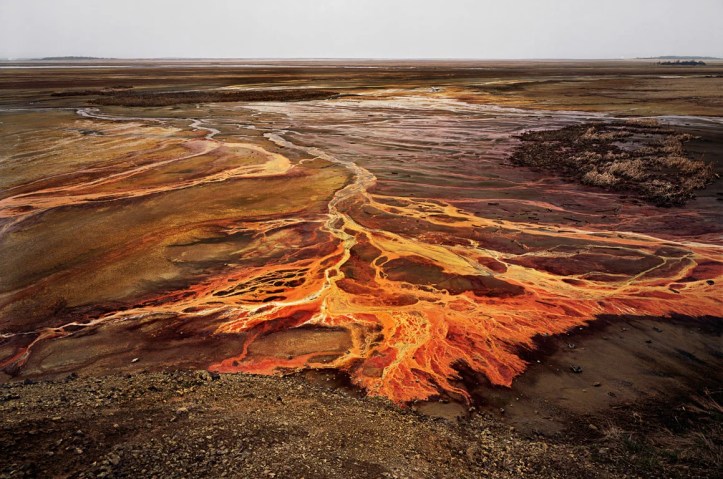
Image at the top: “Earth Scars #14: Ekati Diamond Mine” 12″x24″ Mixed Media on Canvas, by Peter Adams. Ekati is an open pit diamond mine and also an underground mine in the Northwest Territories, 300 km from Yellowknife.
 Another ruined dinner party...
[…] see Part I here […]
LikeLike