Also published in 16-31 Oct/25 issue of

I saw an excellent 27-minute film on the weekend.
Every bit of footage, and interview took place in Gaza and the West Bank. It was a Gaza that no western journalist has been allowed to visit, however briefly.
A Gaza that no journalist, filmmaker or photographer has been permitted to see.
Almost all the photos, the videos we see and most interviews with Palestinians in Gaza are done by very brave and very unlucky Palestinian journalists in Gaza who are trapped. More than 233 journalists have been targeted and murdered by Israel in the last two years.
Today’s film a documentary Samidoun: The Steadfast Women of Palestine I watched online; it was presented by the Palestine Museum-US. You can sign up and watch a new film about Palestine for free every Saturday afternoon.
Eight Palestinian Women Speak…
Of all the films I’ve seen about Palestinians’ living under occupation, and Palestinians in Gaza under sentences of death, this is the only one that focuses on women. Eight women talk about their daily lives under the threat of Israel’s bombs, missiles and tank fire. What we see is the women’s hopes and even future plans while dodging missiles, watching relatives die or starve to death, and scrounging food under Israel’s genocide.
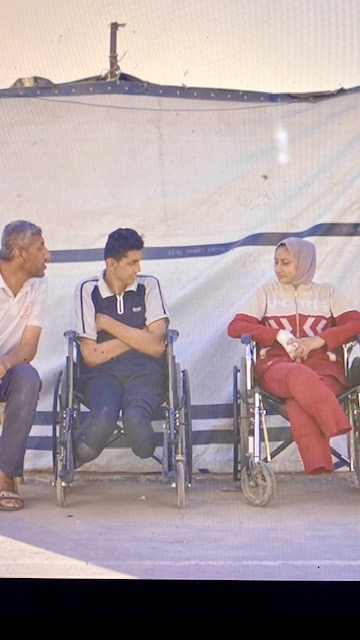
The film opens with a woman sitting in a manual wheelchair navigating the grey destruction of Gaza City. She faces the camera, and you see her pants flapping in the breeze—where her legs once were. Reema was a nursing student. In early December 2023, Israel’s war on Gaza was at the two month mark when her neighbourhood was bombed. She and her family fled to her grandfather’s. The roof collapsed after an Israeli missile strike, killing Reema’s grandfather and cousins. She and her brother survived, each lost both legs. Reema also lost her fingers on her right hand. Now we see her and her brother, with a relative, sitting outside their tent.
There is the story of Asma, a surgeon in a hospital in Nablus in the West Bank. She’s no more than 35-years-old, and says she can count the number of Palestinian female surgeons on one hand. We need to train more. She calmly explained what the Israeli soldiers do,
“Patients are prevented from coming to and leaving from hospital. Medical teams, both men and women, are threatened, stopped and searched. Troops invade hospitals and make arrests inside ambulances and hospitals. In Jenin Camp, [the IDF] assassinated people inside the hospital.”

Aya is a social media journalist. Her brother and father were carrying a sack of flour and water when they were killed by an Israeli armed drone. She borrowed money from a friend from abroad to buy a mobile phone. Now she films fellow Palestinians who tell their stories, and hopes to earn money to support her family.

Diala is a lawyer who represented prisoners jailed by the Palestinian Authority. Then she was also jailed by the Palestinian Authority in 2021. When she was released, she started to visit prisoners in Israeli jails. Then she was arrested by the IDF, she was beaten badly, subject to rats and insects in prison and spent more than a month in solitary confinement before being released.
“When we menstruated, they refused to give us sanitary pads. They’d say ‘wait till tomorrow.’” she remembers.
“There is no escape from the conclusion that Israel has employed sexual and gender-based violence against Palestinians to terrorize them and perpetuate a system of oppression that undermines their right to self-determination.”
Navi Pillay, chair of the UN Independent International Commission of Inquiry on the Occupied Palestinian territory, 12 March, 2025
Sama is a violinist and choir member. She lost an uncle and cousins because of Israel’s war on Gaza. She studied music at a conservatory that was destroyed by the Israelis. Now living in a tent in Gaza City she volunteers to teach children violin and singing.
Don’t let the word Samidoun in the film’s title throw you off. It is derived from the Arabic “sumud”, as in the name of the recent flotilla. Samidoun means “the steadfast ones” There’s a Canadian organization by that name, which has been deemed a “terrorist” group by the federal government. Founded in 2024 that organization is an advocacy group for Palestinian prisoner solidarity. At one time, it raised funds for the political group, the PFLP (Popular Front for the Liberation of Palestine) which has also been deemed terrorist. Thus, guilt by association. Today it helps to organize protests for Gaza.
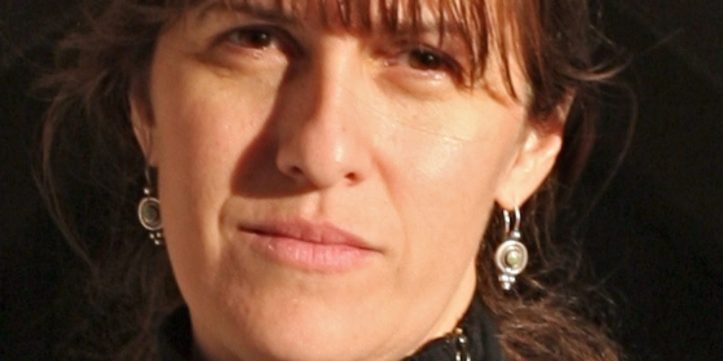
Samidoun, the movie, was made by Mariam Shahin, who lives in Palestine but grew up in Montreal and lived in Europe. Her sources for the contacts, the video and the interviewers were Palestinian journalists on the ground in Gaza. Funded by the Nobel Women’s Initiative – a group of Nobel prize winners who work with activists and organizations to “build peace, defend justice and champion equality for all.” Three women Nobel laureates learned more about the film when they went to the West Bank to interview Palestinian women; the Nobel winners saw Israeli apartheid at first hand.
This documentary says women are important. They are not simply mothers and wives – which is the way that the media tends to portray Palestinian females. They are active, educated and survivors of Israel’s vicious occupation and now victims of its genocide.
You can watch Samidoun here Samidoun – The Steadfast Women of Palestine.
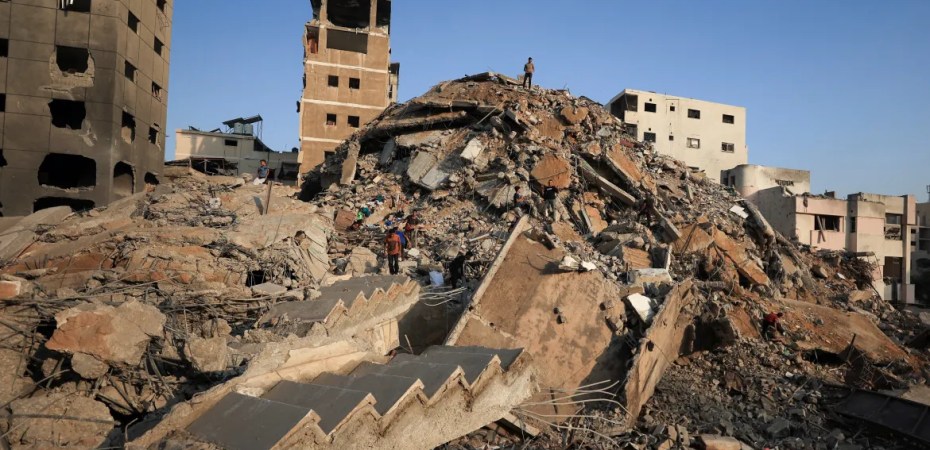
Photo at the top: The Government Media Office in Gaza condemned Israel’s “systematic bombing” of civilian buildings, saying the aim of the offensive was “extermination and forced displacement”. [credit: Dawoud Abu Alkas/Reuters]
 Another ruined dinner party...