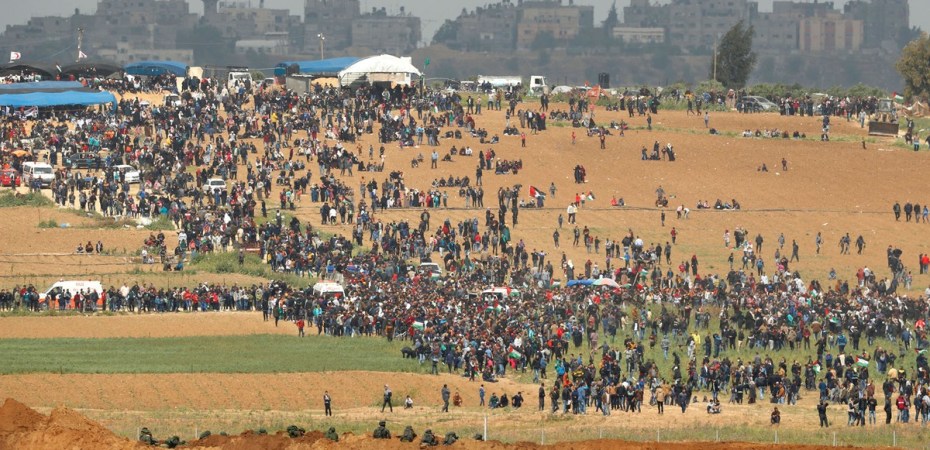
Sunday 30 March is Land Day. Forty-nine years ago, in 1976, Israel disclosed a plan to steal 20 square km of land between two Arab villages, as part of the Judaization of the Galillee. These were Palestinian citizens of Israel who lived in the villages, and those around them. They called a general strike and organized marches from Galilee to the Negev. The Israeli military responded viciously, killing six unarmed demonstrators, injuring a hundred more, and incarcerating one hundred Palestinians.
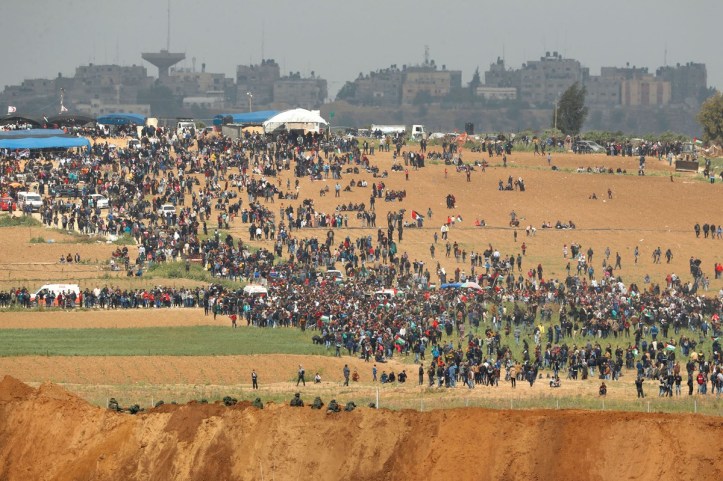
It was on Land Day in 2018 that Gazans began weekly non-violent demonstrations they called the Great March of Return. That first day, more than 30,000 unarmed Gazans decided to walk to the wall, or the barbed wire barrier fence, between Gaza and Israel. They called for an end to Israel’s impoverishing blockade of Gaza’s land, sea and blockade. The Gazans also demanded their right of return to homes and land in Israel after Israel drove three quarters of a million Palestinians off their land at the time of the Nakba, 1948.
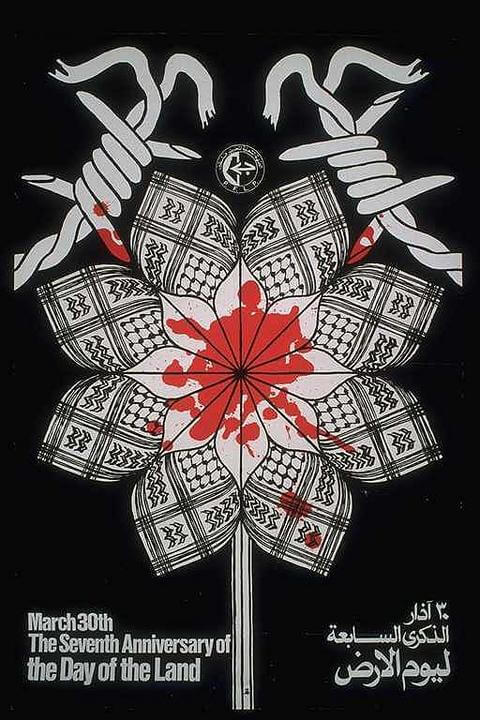
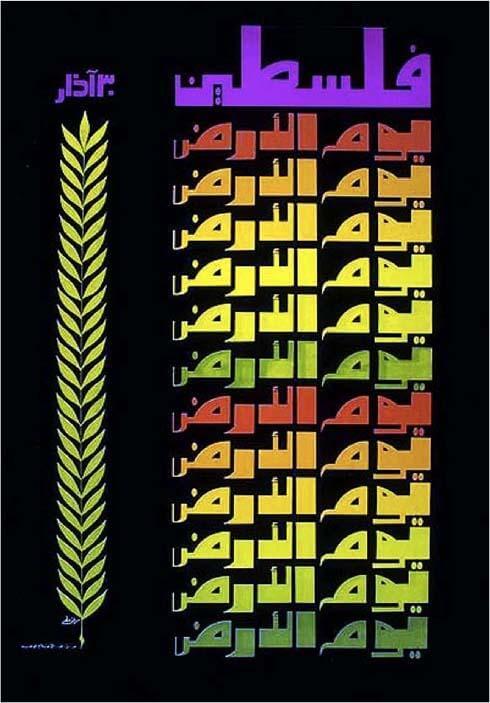
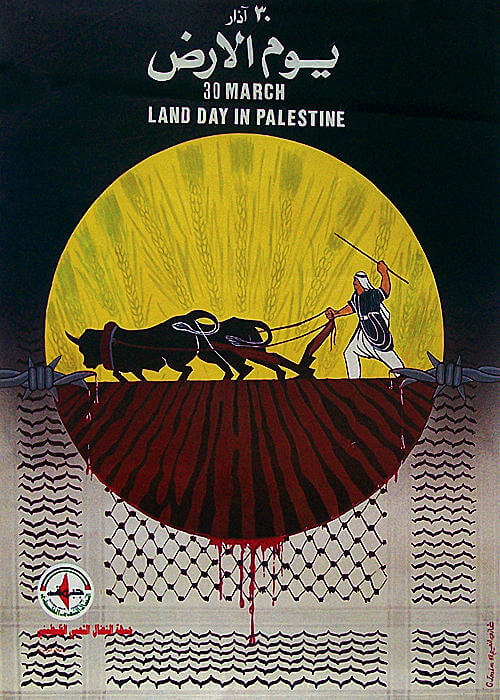
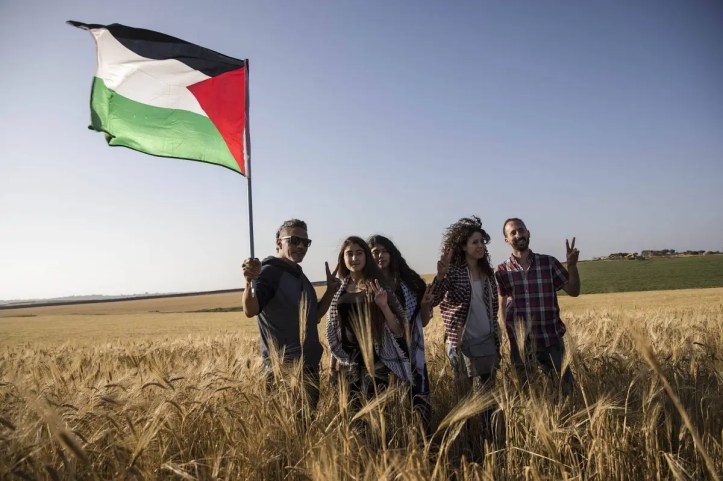
Below: Land Day posters in past years

According to MSF Medecins sans Frontieres–
Israeli soldiers fired bullets at protestors on the assumption that anyone – including people under the age of 18 – approaching the fence was a legitimate target.
The Great March of Return, 2018-2019
Thousands of demonstrators have sustained severe gunshot wounds, mostly in the legs, shattering bones. Between the first protest and November 2019, more than 35,600 demonstrators were injured, 7,996 with live ammunition, according to the United Nations Office for the Coordination of Humanitarian Affairs (OCHA).
Though the Great March of Return started only seven years ago, it might as well be a half-century ago. Suddenly, watching the video from MSF here, I realize that in today’s Gaza, almost all those injured people would have died. Unlike seven years ago, today there are few even semi-functioning hospitals, virtually no operating rooms, so little available oxygen, medications or pain killers that the (mainly) men you see in the video could not have survived their injuries today.
One person who may not have made a good recovery from his injuries had they happened today is Dr Tarek Loubani, a Palestinian-Canadian raised in Bathurst, New Brunswick. On the 14 May 2018, Loubani was an emergency physician trying to help Palestinians during the Great March of Return. Israeli troops were especially vicious that day as it was also the 70th anniversary of Israeli “independence” or what Palestinians and their supporters call the Nakba. Israel shot and killed 60 Palestinians that day at various points near the border as they stood unarmed in protest.
Israeli snipers also shot and injured 19 medical personnel. Dr Loubani was one of them. A doctor, Tarek Loubani, was marked as such as he wore hospital greens; he stood well back from the fence. A sniper’s bullets hit him; Loubani sustained a “moderate” wound to his left leg and a minor injury to his right knee. One of the paramedics who treated Loubani was killed later the same day. Musa Abuhassanin had trained with Loubani and the two knew each other and got along well. Said Loubani to Amy Goodman on Democracy Now!
“…About an hour after he rescued me, he ended up going back to the field on a call, and, unfortunately, he was shot in the chest. There was so much fire around him and so much live ammunition that his colleagues couldn’t get to him and couldn’t treat him. And when they finally did get to him, it was about 20 minutes later. The problem he had, it’s called a pneumothorax, basically air where it shouldn’t be in the chest. And it shouldn’t have killed him. I knew how to fix it. If I were there, I could have fixed it with literally a BIC pen. But, unfortunately, he couldn’t receive the treatment he needed, and he died.”
Canada’s then-Prime Minister Justin Trudeau said “We are appalled that Dr. Tarek Loubani, a Canadian citizen, is among the wounded—along with so many unarmed people, including civilians, members of the media, first responders, and children.” Trudeau called for an immediate independent investigation into the killings in Gaza.
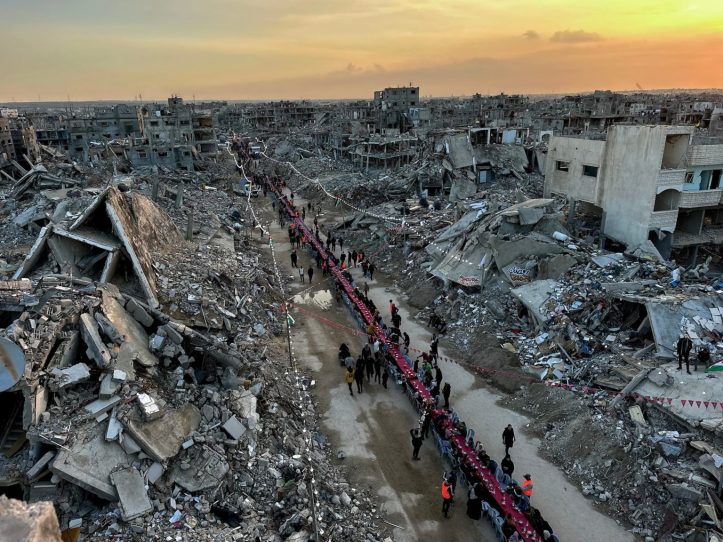
Palestinians break their fast during the holy month of Ramadan near the rubble of buildings in the southern Gaza Strip, on 1 March 2025 (credit: DOAA-El-Baz/APA Images)
There was no real investigation and certainly the Canadian government shrank back to its normal low profile – one of subservience to the pro-Israel lobby, and to the US.
At almost the precise moment Loubani was shot, a delegation of Halifax campaigners for Palestine were meeting with Halifax Liberal MP, now Halifax mayor Andy Fillmore in his office to discuss Palestine. Fillmore was listening politely but non-committedly when one of the delegation received a cellphone bulletin that Tarek had been shot. Fillmore seemed to rouse from his equanimity, expressing some shock and promising he would speak to Justin Trudeau about it.
After Tarek’s recovery and return to Canada, he met with the Prime Minister and other MPs. Loubani asked for $15 million from the Canadian government to support an initiative to install solar panels on the roofs of hospitals and medical clinics in Gaza. Though Trudeau promised money, none of it was ever forthcoming.
3-D Printed Stethoscopes Cost $2.50
Today Loubani is an emergency room doctor in London, Ont., and an assistant professor of medicine at Western University. He started a charity called Glia which creates low-cost or open-source medical supplies to people in “low resource settings.” For example, Loubani designed a low-cost stethoscope which can be made for $2.50 using a 3D printer. Stethoscopes usually retail for $60 to $150.
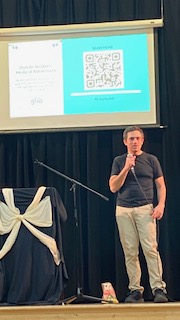
Loubani recently spoke about his experiences to a standing room only crowd at the Ummah Mosque in Halifax, co-sponsored by Independent Jewish Voices Canada (ijvcanada.org). He spoke at length about the patients he cared for, the Palestinian doctors and paramedics and about that frightening day back in 2018. To celebrate Ramadan, IJV and Loubani’s nonprofit Glia decided to have a fundraiser; with the excellent help of Palestinian-Canadian comedian Mohamad El-Attar “That Muslim Guy” who was emcee . People at the event contributed more than $60,000 to Glia.
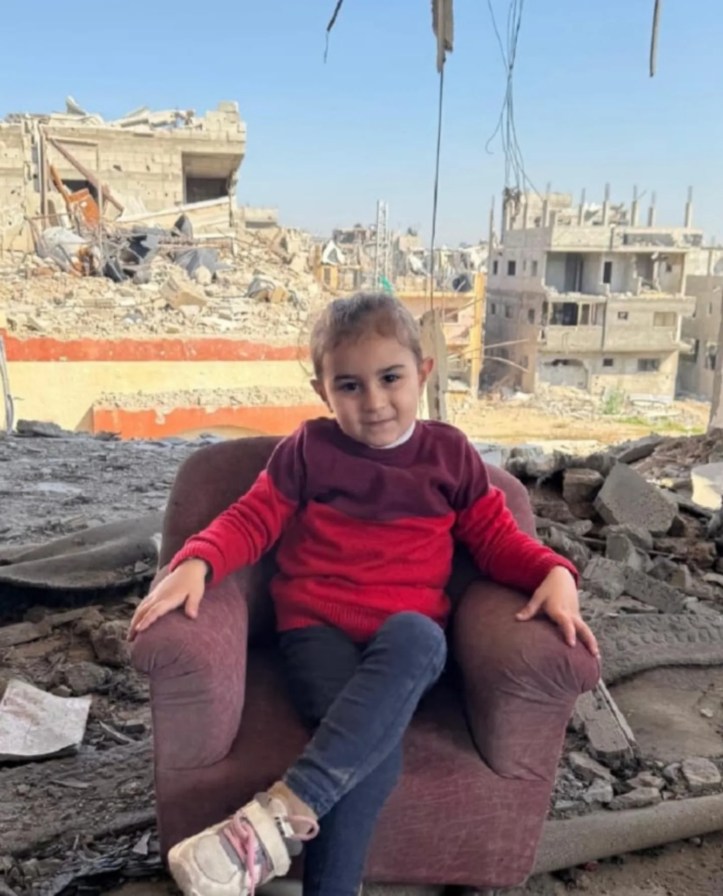
Today marks the end of Ramadan with the celebration of Eid Al-Fitr. I wrote about this last year when Palestinians in Gaza were – as they are today – getting bombed, living homeless in the streets, and living a hand-to-mouth existence. Since 2 March Israel has allowed in no aid, no aid workers, no clean water, no food, no medicine; some would say the Gazans are living on air. We read more and more reports of massacres and murders by the IDF (Israel Defense Forces). For example, barely two weeks ago Israel killed more than 300 women and children in cold blood. Israeli missiles hit dozens of sites in Gaza, aimed at eradicating Palestinian civilians. Bombs struck around 2.30 am on 18 March as Muslims were eating the Suhoor meal before dawn. They ate a meal at that time because, during Ramadan, there would be no eating or even taking water or tea again till nightfall. But many Palestinians didn’t live that long.
“We’ve worked throughout the entire night. The bombing has been nonstop… We’ve run out of all painkillers… There are seven girls getting their legs amputated, no anesthesia… It was mostly women and children, burned head to toe, limbs missing, heads missing.”
Dr. Mohammed Mustafa, an emergency room doctor from Australia, who was volunteering in Gaza City.
Dr Sakib Rokadiya, a UK surgeon volunteering at the Nasser Hospital, in Khan Yunis, told Associated Press reporters: “What stunned doctors was the number of children… Just child after child, young patient after young patient.”
Dr Mohammed Mustafa, an emergency physician from Australia, was volunteering that night at the Baptist Hospital in Gaza City. He said,
“We’ve worked throughout the entire night. The bombing has been nonstop… We’ve run out of all painkillers… There are seven girls getting their legs amputated, no anesthesia… It was mostly women and children, burned head to toe, limbs missing, heads missing. [A man] died on the way to the CT scan…. [The] three girls lying on the bed, they’re his girls. They are now orphaned. Their mother didn’t even make it into the hospital. She was killed along with their other sister… I was here in June, nothing to this intensity… The screams are everywhere… The smell of burned flesh is still in my nose.”
As Israel’s left-of-centre newspaper Ha’aretz noted, the Palestinian Health Ministry reported 436 killed in the attack including 183 children, 94 women and 34 people over the age of 65. According to Ha’aretz’ Bar Peleg, “The night between March 17 and 18 is said to have been one of the deadliest since the start of the war.”
To see a timeline of where and when the Israeli military killed 50,000 Palestinians, read 50,000 Palestinians Have Been Killed in Gaza – This is how it happened day by day. The massacres of tens of thousands of Palestinians has nothing whatever to do with fighting antisemitism. Antisemitism has proved a convenient scapegoat to justify the annihilation of Palestinian people and place. The fight against antisemitism has become an absurd and utterly dishonest excuse for Israel’s ethnic cleansing and mass murder.
Featured photo at the top:
 Another ruined dinner party...