
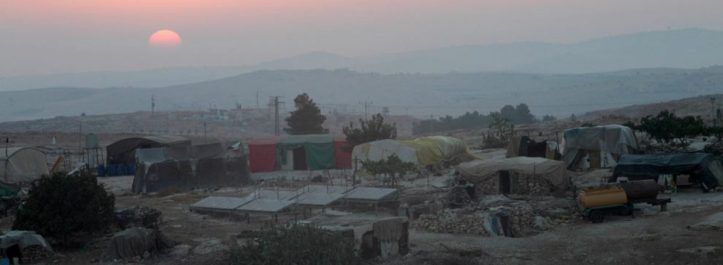
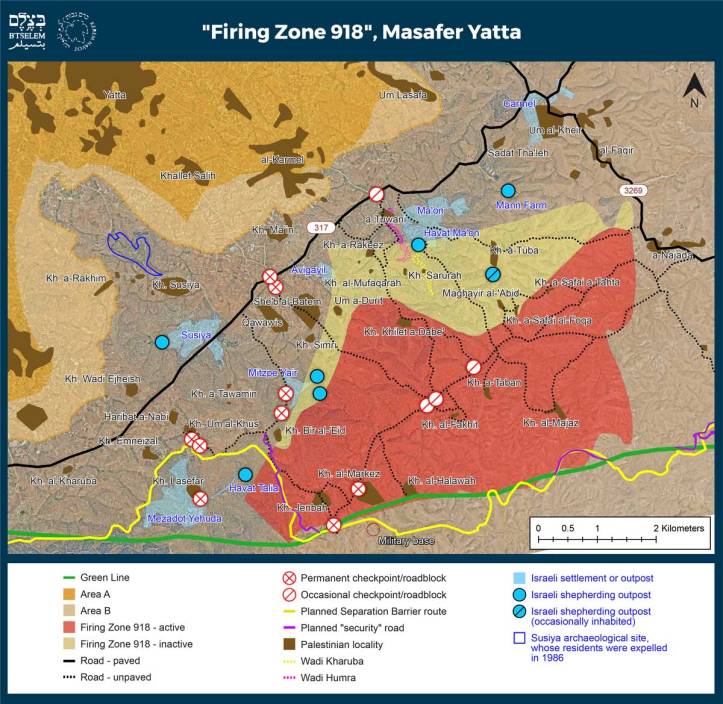
The panoramic view of the South Hebron Hills at the start of the film reveals no trees. No shrub or bush above two metres high at any rate. In this parched and rugged setting are the 20 Palestinian villages that make up Masafer Yatta.
Early in their relationship, we see the young Jewish man Yuval Abraham trying to engage a Palestinian videographer, Basel Adra. How does Yuval speak such good Arabic,and how does he manage to live in Basel’s village and inspire Basel to co-direct what has become an earth-shaking documentary No Other Land.
I realize this is the most violent documentary I’ve ever seen.
The violence – what we see and what we don’t — is, of course, due to the relentless attacks by the Israeli Defence Forces (IDF) and by the illegal Israeli settlers. Both groups are armed to the teeth. But as someone pointed out to me, if the Palestinians of Masafer Yatta had been armed, they would have all been killed – mowed down by the IDF and their helpmates the Jewish settlers.
Basel has been taking videos to document the many marches and rallies his fellow villagers in the South Hebron Hills have held to try to stop Israel from stealing their land, and even their sheep– their livelihood.
“An armed robbery that deteriorated into a murder attempt”
Israeli journalist Gideon Levy in Ha’aretz
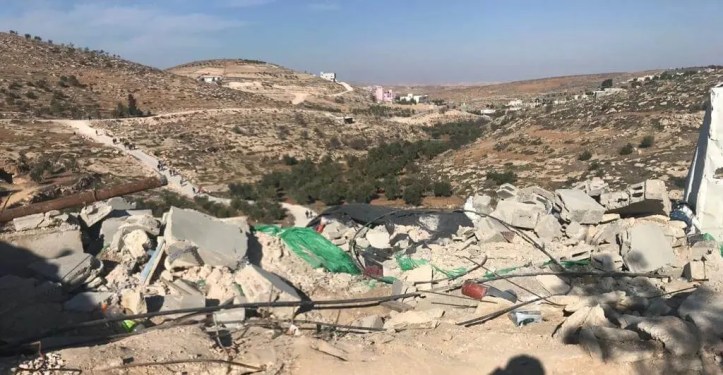
In November 2020, the IDF came to the village with bulldozers to destroy Harun Abu Aram’s house – because it didn’t have the requisite building permit. The overwhelming majority of Palestinian homes destroyed are because Israel won’t grant them a permit to build. This is strictly political – a way of Israel limiting Palestinians’ land and future. Harun’s was one of 639 buildings in the West Bank demolished in 2019. From 2023 to March 2025, Israel has demolished more than 33,000 houses, warehouses, and animal shelters on the West Bank.
Though the film does not show the destruction of Harun’s house—it does show the family living in a cave when the IDF returns to stop Harun and other villagers from helping a neighbour rebuild his house. The soldiers grab equipment including an electric generator in order to halt construction. As Israeli journalist Gideon Levy wrote, it was “an armed robbery that deteriorated into a murder attempt”.
Harun tries to wrestle the generator away from a soldier who then shoots Harun in the neck at point blank range. Harun, aged just 24, instantly became paralysed from the neck down. Then the soldiers fired guns toward the car that tried to take him to hospital.
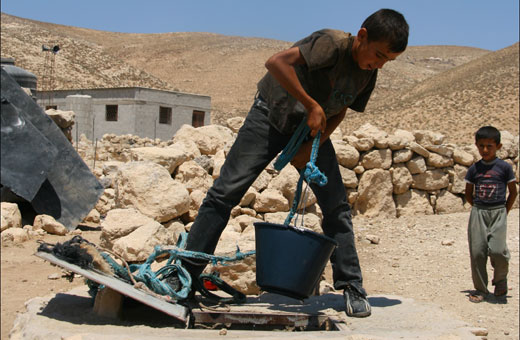
In No Other Land, we see how Harun and his extended family are forced to live in a dirty stone cave, with no clean air, or water. Indeed water needs to be trucked into the village at a cost of at least $10 US a cubic metre — four times the price of water charged to residents of Israel.
Harun is forced to lie in pain all day and night on an uncomfortable beach lounge chair with no way to sit, to bathe, to even see sunlight. Harun’s mother and unpaid caregiver, a woman in her 40s, is in total despair about her son’s worsening condition, the threat of infected bedsores, and the lack of any ongoing medical help for him.
In other words, Palestinians who build a house or help a friend build on their own Palestinian property face death — or a living death as in Harun’s case.
No Other Land shows a film crew and Israeli journalist Gideon Levy and his photographer Alex Levac approach Harun’s cave to interview him. From inside the cave Harun yells for them to not enter. He can’t bear the media seeing his impoverished state of disability and despair. Harun died of a severe infection early in 2023 having lived in the dirty cave with no running water for two years. Israel refused to allow the family to rebuild their modest home so Harun could live in a decent room – despite the fact it was a Jewish soldier who shot Harun and caused his catastrophic injury.

In another scene, Israeli soldiers storm a two-room school in a Masafer Yatta village. At first the soldiers lock the children in the classroom but when the bulldozer arrives, villagers panic and let the children leave through a window when the bulldozer starts to destroy their classroom. We see some of the village men manage to rescue a few plastic patio tables and chairs which furnished the school. After the soldiers leave, by day the women start to rescue what they can from the school ruins. Under cover of darkness, village men begin to rebuild it.
The city nearest Masafer Yatta is Hebron. I’ve visited this segregated city (Palestinians have been pushed to the outskirts versus the illegal Jewish settlers who have appropriated Arabs homes, shops and the streets.) In 2009, Britain’s ex-PM Tony Blair went to Hebron and Masafa Yatta as part of a pro-peace Quartet– a group of three nations plus the United Nations. At the time, The Guardian reported that
“Neither Blair nor Bush garnered much respect on the Arab street during their terms in office, and in Blair’s case his subsequent reincarnation as middleman in the Israel-Palestine conflict has not improved his standing among residents of the West Bank or Gaza. As his detractor was hustled away, he continued his rant: “He is not welcome in the land of Palestine”, to which Blair cautioned against seeing one man’s sentiments as representative of all Palestinians’ feelings.”
As a result of Blair’s visit, the Israelis gave a reprieve to Palestinians whose houses were about to be demolished. On the five streets that Blair and his entourage walked along no house would be demolished during his visit.
No Other Land is a look at day-to-day life in the occupied West Bank – now a focus for Israeli violence and destruction. 97% of the destruction and killings have been committed by the IDF and 3% by the Jewish settlers. Since March began dozens of Palestinians have been killed by the IDF and Israeli settlers. Since Oct ’23, more than 370 Palestinians on the West Bank have been killed including 94 children.
More than the attacks on Palestinians, the film shows an unusual relationship between two filmmakers – a Jew and a Palestinian. Basel lives in danger of arrest and worse at the hands of the IDF all the time. Sure it won the Academic Award two weeks ago. But there is still no distributor. Everyone knows why.
Photo at the top: View from Masafer Yatta, West Bank (credit: B’tselem.org)
 Another ruined dinner party...
[…] in 2025 the critically-acclaimed Israeli-Palestinian film about Gaza –No Other Land my review is here—won Best Documentary Feature. Now after Israel has killed more than 73,000 in its war on […]
LikeLike