
What to Watch…
In Dismissed (2017), David Butler is an optimistic high school English teacher trying to connect with his uninterested students. So when honour student Lucas Ward transfers into his class, Butler is thrilled to teach such a passionate teen. Butler’s excitement soon turns to fear when he realizes that Lucas’ behaviour is pathological and that the vengeful student is willing to destroy anyone standing between him and a perfect GPA. Worth watching; it’s on Prime.
Divorce is a 2024 Polish film that is clever and moves fast. A long divorced couple decide to get an annulment so he can marry his current fiancée in the Catholic church. This starts a lot of moving parts in motion; there’s a takedown of the church, an attack on the pen pushers in government and of the entire institution of marriage. This is a funny film. It’s on Netflix.
Two Faces of January is a 2014 thriller on Kanopy is about an American conman and his wife who escape the US to Athens to evade debt collectors and other criminals. The conman is involved in the death of a gang member who tracks him to Greece. The couple meet an American tour guide who tries to help them out. The scenery of Athens and Crete is a nice touch, as are the streetscapes in Istanbul where some of the action takes place. Here is the trailer.
No Offence is a police procedural that takes place in Manchester, UK. The difference between this and other procedurals is the chief inspector and her best detectives are women – and women with an attitude and a track record in apprehending bad guys. The series is refreshing, quick moving and humorous. There are three seasons – I think the first season is the best. The other two are filled with confusing plot twists and a lot of car/truck “action” which sort of cheapens the best parts of the series. It’s on Prime and here’s a trailer.
From the top: Scene from Divorce; scene of teacher in Dismissed; poster for Two Faces of January; Chief Inspector in No Offence and pasta from Chef’s Table.





In Between, is a recent feature film on Kanopy. Three young professional Palestinian women try to navigate their lives in the hostile environment of Tel Aviv – amidst racism and nastiness. Very good and worth watching. The trailer is here.
Chef’s Table is a Neflix documentary series that looks at food around the world, how it’s prepared and what makes it special. I just watched the four episodes about noodles, fascinating. A street smart chef from Los Angeles goes to Bologna, Italy to find out how to make pasta and all the pasta shapes by hand – no machines allowed. The scenery is great, the premise of the series in interesting and we find out how good chefs are fanatical about their cuisine. Watch the trailer.
I noticed a few new episodes of Bosch on Netflix. I’m giving up on him and his daughter who is also a cop. It’s violent, scary and meaningless. But if you liked all those earlier episodes of Bosch, you might like these.
A very intense and well done film is The Palestinian with Vanessa Redgrave. This 1977 two-hour plus documentary gives us a look into what happened to the Palestinians in the 60s and 70s and it includes Redgrave’s interview with the late Yasser Arafat. It’s both inspiring and sad in that we see some possibilities in the film, yet today we see Gaza and what has become of it and the West Bank. Watch it here– below is Redgrave accepting the Oscar for best supporting actress for her role in Julia in 1978. Her acceptance speech was a political tour de force.
Israel’s Mask is Slipping is Chris Hedges’ one hour interview with veteran left-wing British journalist and Editor-in-Chief of Middle East Eye David Hearst about the current situation with the Palestinians — especially in Gaza. This is worth watching – on the Chris Hedges Report
What to Read…
Radioactive Radicals: A Novel of Labor and the Left by Dan La Botz is fascinating. La Botz is a founder of Labor Notes. He is a former Teamsters union organizer, a leading campaigner for IS (International Socialists), and a freelance left-wing journalist. Late in middle age, he becomes a history professor with a specialty in Mexican and South American revolution. This book is autobiographical, written in the first person and centres on himself (Dirk) and his best friend, Wes. Dirk and Wes were born three days apart in August 1945, at the time the Americans dropped two atomic bombs on Hiroshima and Nagasaki. In the novel, Dirk traces the radical struggles of the last fifty years – from the strides unions made, to the corruption of the Teamsters, to Viet Nam, to race relations in the US, to housing crises and more. Married several times, he tries to ignore growing warning signals and keep up the fight for revolutionary aims. I don’t want to give too much away—but an incident in a Detroit scrap yard with a Mafioso has a profound effect on the next thirty years of Dirk and Wes’ radical lives.

This book is a must read if you lived through the 60s, the 70s or have spent any time as a leader of a union or political action group. I can compare this book to the 2001 Canadian nonfiction book, A Very Red Life: The Story of Bill Walsh by Cy Gonick. Gonick is a retired professor of political economy, a former Manitoba NDP-MLA (from 1969 to 1973 in Schreyer’s NDP government), is founder and editor of the venerated left-wing magazine Canadian Dimension.
In the 1990s, Gonick interviewed (former) Communist and union organizer Bill Walsh at length. Walsh and his best friend Dick Steele left Montreal for the Soviet Union in the 1930s, where they worked in factories, developed skills, sympathy for the USSR, and learned Russian. They returned to Canada only to be dispatched to fight in Holland and Belgium in WWII. Steele was killed – a tragedy that affected Walsh for life. In fact, when Walsh returned home, he married Steele’s widow, and adopted her two sons. Walsh and Steele’s relationship and political commitment – two Communists trying to change the world – reminded me of the depth and strength of Dirk and Wes’ friendship.
Walsh helped to organize a union for the rubber workers in Kitchener, Ont. and then auto workers in Windsor, Ont. From 1940-42, Walsh was jailed and interned along with several hundred other Communists. After the war he held a staff job with the Communist-leaning United Electrical Workers (UE) union in Hamilton, Ont. He held the job for more than 20 years.
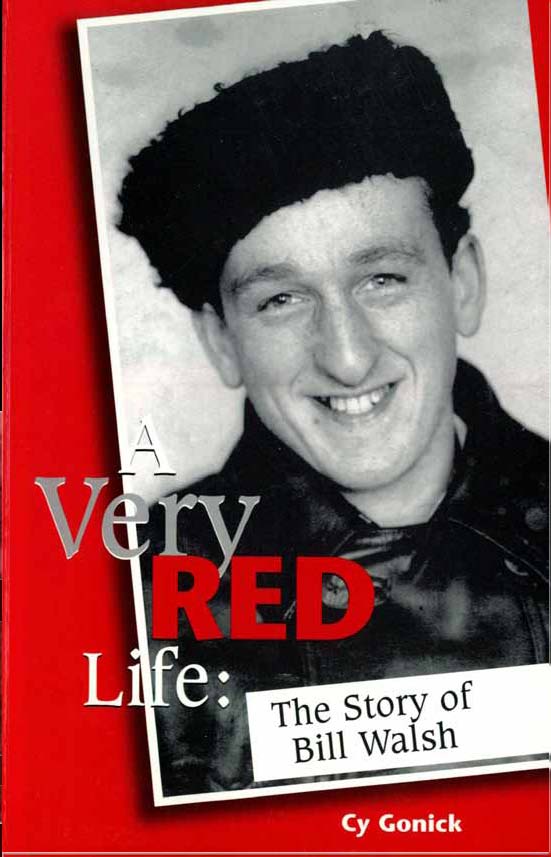
I recommend both books, though they are different. Radioactive Radicals is an American tale, about two men, one from Chicago the other from a farm in the Midwest, who decided to rattle the chains of arguably the biggest (and most corrupt) union in the US. Both men evaded the draft and didn’t go to Viet Nam. Yet their bond and their dedication to the socialist cause propelled them through decades of struggle within the Teamsters, and the broader political wilderness. A Very Red Life, reports on struggles 30 years earlier. We read about the lives of two Canadian Jews who dedicated themselves to the Communist Party of Canada, and to forging workers’ rights through industrial unionism.
Furtively, I read another John Grisham legal thriller, The Reckoning. I like the legal-court room stuff – did you know the authorities used to bring the electric chair right into southern US courtrooms to “fry” guilty “miscreants”—at least it was done in this book. Wow. But I was not wild about the white family’s saga, their war record, cotton plantation and 1940s small town Mississippi. I think the book’s first half is worth reading, but not the second half. Instead jump to the last 50 pages to find out the end.
Why Women Aren’t Welcome on the Internet is a 2014 article which explains a lot about the misogyny, the threats against women, the mansplaining, the name calling and the insults — and death threats — accorded women on the net.

What really happened to Wanda Nanibush — former curator of Indigenous art for the Art Gallery of Ontario? After 7 Oct last year Nanibush refused to be silent and condemned Israel’s attacks and then genocide against Palestinians in Gaza. For that, after seven years on the job at the prestigious gallery, Nanibush no longer worked there. There were demonstrations, pleas to rehire her, and letters to the editor that supported her. A new article in The Walrus, The AGO vs Wanda Nanibush by Jason McBride goes a long way to explaining Nanibush’s activism, and her refusal to back down in the face of a gallery board dominated by the pro-Israel lobbyists and pressure from “Official” Canadian Jews. Of course the mention of the pro-Israel lobby and “Official” Canadian Jews are never mentioned, but they are clearly the elephant in the room. Here’s the article– well worth the read. Nanibush is another casualty of nothing less than a campaign of censorship and civil terror against those who support Palestinians’ right to exist. The reign of civil terror by the pro-Israel lobby and the “Official” Jews is indeed despicable. My son Max Haiven, a specialist in cultural studies, calls it “the unrelenting war of position.” There is no endgame– everything is an excuse for Israel to bomb, launch deadly missiles and sniper attacks.
Nanibush isn’t talking and that is most likely because she signed an NDA (Non-disclosure agreement) and was paid one or two years’ salary to leave the AGO. Most NDAs demand the victim of the firing never speak or write about the events that were career-ending. Read about The Empty Chair below to learn about NDAs. With a heavy heart, I read it here.

What to Listen to…
A four-minute rap song One Whole Year of Genocide, about Gaza. Excellent, listen here
The Empty Chair: Excerpts from testimonies by people who have signed NDAs (Non-disclosure Agreements) is only 5 minutes long. But it packs a punch; one third of the US workforce is bound by NDAs. You can listen to woman after woman forced to sign an NDA, after receiving a paltry sum of money and shown the door of her workplace. Employers use NDAs to silence victims of harassment and discrimination; they also use NDAs to hide misconduct. Usually the woman victim is tossed from her job and has her life destroyed because she dared to complain. Research tells us that for all the women who were forced out of their job, or education -– the male perpetrators invariably kept their jobs and went on to harass and even assault other women in the workplace.
For more on this topic, watch Equity Watch’s webinar about NDAs and harassment at work here.
There is the shocking case of Gisèle Pelicot, 70, in Avignon, France. Dominique, her husband of 40 years, drugged and raped her and allowed more than 50 other men to rape her while she was unconscious. The court case is reported here. Dominique actually filmed the rapes and assaults. The men, aged from 26 to 74, included firefighters, journalists and tradesmen. Here is a good podcast from The Guardian Australia about it.
Below left, ‘Shame must change sides’ has become a motto for feminist women. (Credit: Jonathan Ribboah, DW) Mohamad Salaheldin Abdelg Alsayed/Anadolu/picture alliance). Right: a photo of Ms Pelicot (Credit: Christophe Simon/AFP).


Ars Gratia Artis (Art for Art’s Sake)
57 seconds: The average person on a train can look out the window. But these passengers don’t. Have a look here.
The Guardian in the UK reports on efforts by campaigners to fight for better UK paternity leave – which is the worst in Europe. Activists are tying baby slings to statues in London and using dolls as babies to capture the public’s attention.
Left: the statue of American dancer Gene Kelly in Leicester Square. The “Dad Shift” campaign founders said they wanted the result to be a “positively provocative sight.” (Credit: Graeme Robertson/The Guardian). Right is the statue of Isambard Kingdom Brunel at Paddington station. (Credit: Graeme Robertson/The Guardian).


Cartoons by Quino…
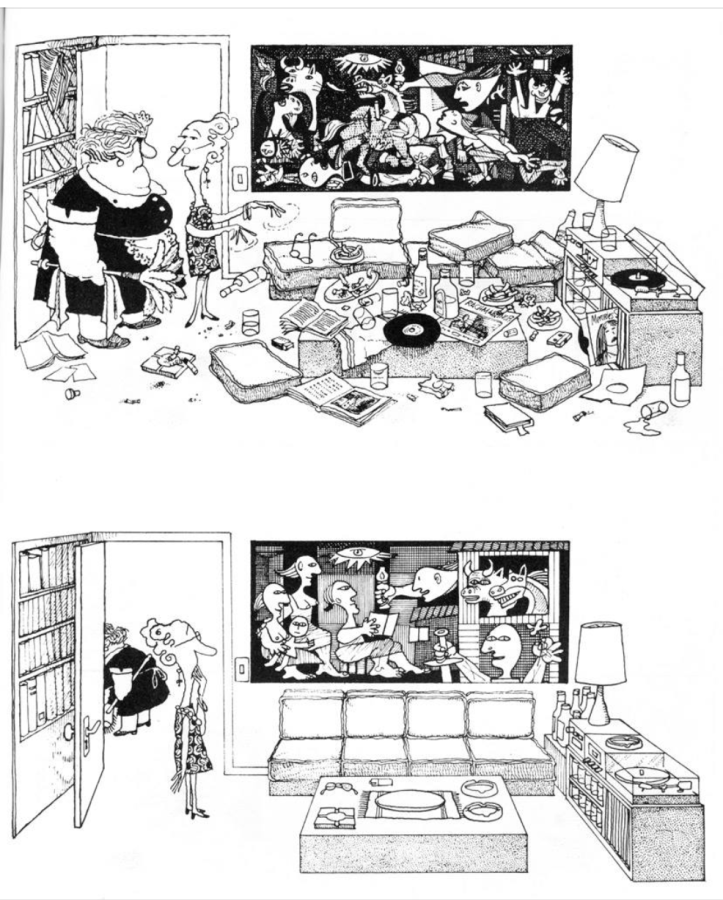
Photo at the top: Demonstration outside the Avignon courthouse for the Pelicot trial (credit: Mohamad Salaheldin Abdelg Alsayed/Anadolu/picture alliance).
 Another ruined dinner party...