A Halifax couple, Judy Howe, age 77, and George 80 years old had been renovicted from their rental apartment. After six months with no place affordable to go, they moved to the grassy median on University Ave – where 30 others were living in tents. They had no choice.
Even if they had rented a bargain basement hotel room somewhere on the city’s outskirts, the couple couldn’t have afforded more than five days of accommodation. Most hotels now, in tourist season, charge more than $300 a night.
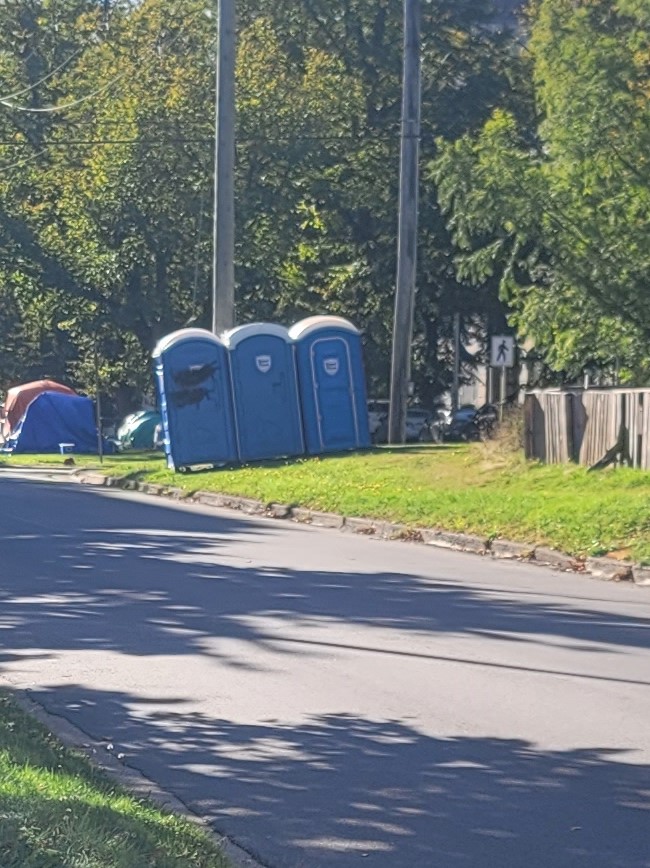
I walk up University Avenue and see the three outhouses (tilted at 10 degrees) – to serve the thirty people living on the median.
I walk up University Avenue and see the three outhouses (tilted at 10 degrees) – to serve the thirty or more people living on the median. There is no water to wash with. Instead the city delivers cases of small bottled drinking water every few days.
Portapotties vs Leaning Tower of Pisa
The three attached tilted portapotties illustrate exactly what HRM, our councillors and the mayor, think of the homeless. Using a toilet in an outhouse on a small hill tilted to about 10 degrees can’t be comfortable, or even safe. It’s probably a little like if you had to use a toilet in the leaning tower of Pisa– it’s at a 3.99 degree angle – the portapotties’ angle is 2½ times worse.

Everyone over age 60 has something wrong with them – whether diabetes, high blood pressure, heart problems, depression or mobility issues. Older people who have to live rough have to suffer with their own illnesses or frailty plus lack of hot or cold running water, sleeping on mats or mattresses a few inches on top of the cold ground, and keeping their food stash safe. There is no place to wash the clothes or dishes, to bathe and very little security or privacy.
1287 “actively homeless” in Halifax
Word got around about Judy and George, the homeless couple. A nice leasing agent offered them an “affordable” apartment, so their stay in a tent on University Ave was shorter than expected. A good samaritan paid their first month’s rent, and someone else is subsidizing the couple’s monthly rent.
So the older couples sleeping rough got an apartment. What about the others? There are more than 1287 “actively homeless” people in Halifax. Scores are sleeping rough most nights. Some are older people who have been tossed out of their housing after years of being decent tenants. More than 41% of homeless people first became homeless during the pandemic.
27% of the homeless are former youth in care; 58% suffer from brain injury or cognitive delays…
Halifax Housing and Homeless Update 2024 here
In March 2024, Max Chauvin, HRM’s Director of Housing & Homelessness, published a report that noted the following:
- 27% of the homeless are former youth in care;
- 37% are physically disabled;
- 58% suffer from a brain injury or cognitive problem;
- 63% have mental health issues.
Chauvin responded to the problem of homelessness on CBC Radio One’s Information Morning last week. He said that everyone tenting on University Ave. has been warned there will be no tenting there after Nov. 1 due to “safety concerns”. He said that when winter is here, the huge ploughs come down the narrow street to clear the snow, which could endanger the tenters living on the narrow median. Though Chauvin didn’t say, I guess some tenters would have to struggle and slip over big snow banks created by the ploughs, and others could fall into the way of the ploughs since most tents are pitched nearer the road. The portapotties are located only about a metre away from westbound traffic.
So what is Chauvin’s solution as of Nov. 1? Well, he says the people can go to a provincially- funded shelter. He didn’t dare say the tenters should just move to one of the other three camping sites in Halifax, or two sites in Dartmouth.
Provincially-funded shelters in Halifax amount to a few dozen beds at the Salvation Army shelter, Metro Turning Point, and the Emergency Shelter on Young St. if there is space. Then there are the tiny homes, and the Pallet homes; to get into those, you have to be on a list with a service provider. Judy Howe was offered a Pallet home on Atlantic St. but declined it because it was for a single person – where would her partner George go?
According to the Farmers’ Almanac, the first frost in Halifax is predicted for 20 October. What are people in tents or lean-tos to do without heating, cooking facilities or a safe place to sleep or live? A notice posted in the University Ave encampment says that under the Protection of Property Act, any encampment residents who don’t leave by the deadline could be arrested and removed from the median, or fined.
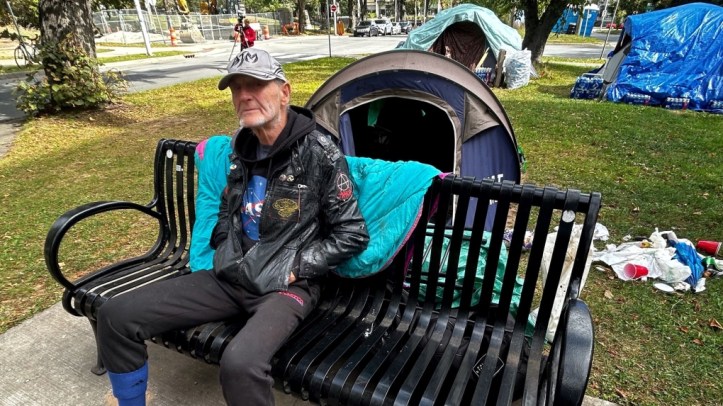
We know there are fewer places for the homeless to go. Clearly tents are not serious responses to the crisis of affordability, nor are the tiny or Pallet homes which tend to accommodate singles for a maximum of a few months. They are not meant to be permanent.
Across Canada there has been little long-term success with the traditional “Treatment First” or “Treatment as Usual” way of dealing with the homeless. According to a 2013 Canadian report Treatment First means,
“… people who are homeless are placed in emergency services and then other kinds of supported living environments (such as transitional housing) until they are deemed ‘ready’ for independent living (having received access to health care or treatment) or until housing is available. This service model is often highly regulated and involves expectations of compliance with treatment and abstinence from drugs and alcohol.”
The “Housing First” approach differs significantly from the Treatment First model. As Housing First in Canada: Supporting Communities to End Homelessness Report notes,
“First, through outreach or a targeted approach, people who are homeless are presented with the option of housing, without it being conditional on any lifestyle, behavioural or treatment expectations (such as abstinence). Second, people have some say in terms of the type and location of housing, taking into account the availability of affordable housing in a given community. There is an expectation that housing be of reasonable quality. Third, people are rehoused as rapidly as possible, minimizing time spent absolutely homeless or in emergency services. Finally, ongoing services and supports are offered and made available to those who want them and need them. These can include rent supplements, case management, help developing connections within the community, etc. For those with addiction issues, housing is not conditional on sobriety. … The Housing First approach works best when it helps people nurture supportive relationships and become meaningfully engaged in their communities.”
Treatment First or Housing First?
While HRM talks a good line about doing what it can for the homeless, HRM and also the Tory government are probably going down the wrong track. They are typically housing people on a Treatment First basis rather than a Housing First basis. Housing FIrst means arranging housing, working with landlords and developers. It means trying to convert unused buildings (including government offices) to apartments, deciding to seriously subsidize rents so that Housing First tenants only need to pay 30% of their income for rent.
HRM and the NS Tories basically are pushing to increase shelter beds and building of short-term tiny homes. We know this because of the fanfare with the openings of tiny villages such as here, here and here. HRM supplies “wrap around services” for some shelter and all village residents, including three meals a day, plus social work help and security.
Housing experts say that by initiating a Housing First policy it could – over time – reduce the needs for homeless services. A 2013 study of homelessness in Toronto, Ottawa and Guelph revealed that 88-94% of the homeless population are transitionally homeless; 3-11% are episodically homeless and 2-4% are chronically homeless. Episodically and chronically homeless people are the targets for Housing First.

But who will take note of the elephant in the room? In HRM, building luxury apartments, and small rental units in high end highrises are the norm. Of the new buildings going up or recently completed, there are very few, if any, suites that are “affordable”. The NS Tories have virtually given away land and thrown money at developer friends who are mainly building tract houses that each comes with a $600,000 price tag. There are a few housing projects built mainly for Indigenous and Black communities which, thanks to federal (and some provincial) funding, will be affordable.
The common “wisdom” insists that if we merely build enough residential buildings, supply and demand will bring prices and rents down. That “wisdom” also insists that “trickle down” will operate i.e. as more new luxury dwellings are built, older luxury buildings will become more affordable. But experience shows that the housing market simply does not operate that way.
The problem remains – 1200 people without safe homes to live in this winter.
We know that despite more than 1800 hotel rooms in the Halifax area, the government is increasingly unwilling to foot the bill for the homeless to stay in hotels during the winter. Hotel rooms are only used in dire circumstances such as -25C temperatures; hotel rooms are not for “typically” unhoused people on every winter day. Where should they go?
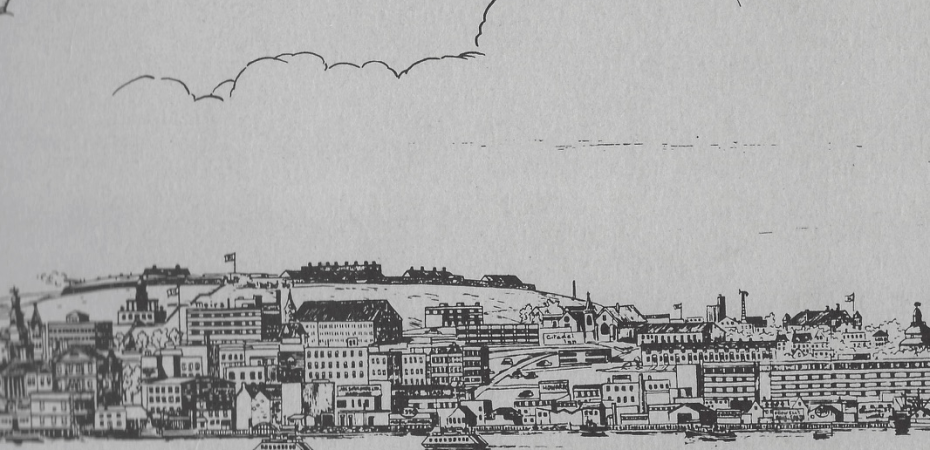
Image at the top: A drawing of Halifax from the Dartmouth side in 1969, by L.B. Jenson.
 Another ruined dinner party...
Thank you for this information and your consistently informative blog, Judy. You bring awareness and knowledge to numerous impactful issues which may not affect us directly but certainly require our attention.
LikeLike
thx
LikeLike