No one reading this believes that journalists should be killed for reporting what is going on in Gaza.
No one reading this thinks that reporters should not report on ‘wars’.
No one reading this believes that a free media exists in every country. Perhaps a few who are reading this know that Israel has deliberately targeted and killed 96 of the 109 journalists who have been murdered in Gaza in the last three months. Fewer realize that more journalists have been killed in Gaza in the last 107 days than in all six years of World War II.
The reason you don’t know is because Canada’s mainstream media doesn’t report any of this. Canada’s small handful of foreign correspondents are “embedded” with the Israelis in Jerusalem – just 77 kilometres but light years from Gaza. Whether it’s Irris Makler, a CBC stringer who makes her home in Jerusalem, or CBC’s veteran international correspondent or several others who report on Gaza, journalists are typically not allowed to go into Gaza. Instead they are treated to press briefings, media reports, army film screenings and briefings with Israeli politicians on the far right, and by IDF generals and their media henchmen.
We also know that the occasional CBC Israel reporter who is especially critical of that country, like Neil Macdonald, faced vicious attacks from pro-Israel groups.
Recently, The Intercept did a quantitative analysis of articles in newspaper coverage of the first six weeks of Israel’s war on Gaza. The Intercept studied three US newspapers “of record,” The New York Times, The Washington Post and the Los Angeles Times. All three newspapers “showed a consistent bias against Palestinians.”
An article published two weeks ago in The Intercept reveals that 48 journalists in Gaza died in the first six weeks of Israel’s war on Gaza. While the war has been one of the deadliest in modern history,
“the word “journalists” and its iterations such as “reporters” and “photojournalists” only appears in nine headlines out of over 1,100 articles studied. … Only 4 of the 9 articles that contained the words journalist/reporter were about Arab reporters.” https:/
From Adam Johnson and Othman Ali in The Intercept, here
CTV’s National News skews the news for Israel a
Journalism in Canada fares even worse. Most newspapers do not even perceive their lack of in-depth coverage on Palestinians and on Gaza. This could be due to the fact that most of the media in this country is controlled by one of several business empires—largest among them is Bell Media. Bell Media owns CTV, CP24 and The Globe and Mail as well as a raft of commercial radio stations. The CTV National News is the most watched news program in Canada.
In a study from 7 Oct. to 7 Nov, 2023, the online Canadian news source, The Breach, found that in its coverage,
“CTV National News has featured 62 per cent more Israeli than Palestinian voices, aired racist stereotypes about Arabs, and allowed Israeli military officials to make false claims without pushback…”
CTV did not “identify 41 per cent of its Palestinian speakers by name—while identifying the vast majority of Israeli speakers with their names as well as family relationships and personal connections to violence they’ve experienced.”
From Emma Paling and Katia Lo Innes at The Breach, here
In total, 133 Israelis and Canadians including politicians, military spokespeople, and relatives of people killed or taken hostage by Hamas had appeared in that one month. By comparison only 82 Palestinians including civilians, officials and Palestinian-Canadian relatives were featured on the newscast.
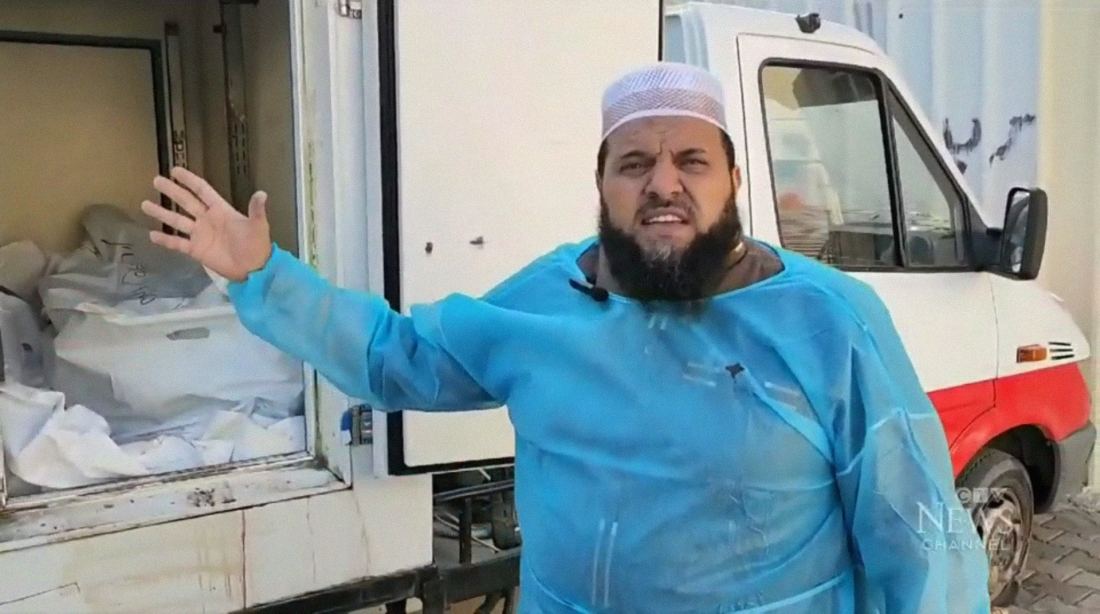
The photo, below, is of an unnamed doctor in Gaza, who was one of 34 Palestinian speakers not identified by name on the CTV National News. He appeared onscreen for eight seconds.
The CBC did not do all that much better. According to an article published in VICE on 21 May, 2021–nearly three years ago– two journalists from the CBC said they had been barred from covering the “ongoing violence in Israel and the Palestinian territories” after they had signed an open letter which called for more “nuanced coverage.”
More than 2,000 people, including many journalists, signed an “open letter to Canadian newsrooms.” The open letter said that the Canadian media did not include enough context or voices of Palestinians when covering “the oncoing nature of the Israeli occupation.” It asked for “fair and balanced coverage” of the conflict.
The letter was published a week after Israeli air strikes killed 228 Palestinians, including children, in Gaza.
The letter also noted the CBC’s decision not to cover a Human Rights Watch report that described Israel’s behaviour toward Palestinians as apartheid.
The VICE article quotes a number of CBC journalists who had to remain anonymous as they feared repercussions on their careers for speaking out.
“The more evocative and sympathy-generating terms don’t apply to Palestinian deaths, the CBC argues, because Israel carries out its killings “remotely” instead of face-to-face.”
CBC quoted here
Both-sides-ism
Another issue the journalists raised was “both-sides-ism” – the fact that reporters are meant to cover both sides of the conflict even-handedly despite the “disproportionate power dynamics favouring Israel.” Journalists signed the open letter because of a concerted effort within Canadian media to “both sides” the conflict, despite the disproportionate power dynamics favouring Israel.
After a complaint filed by a member of the public, the CBC agreed that they used words such as
“murderous,” “vicious,” “brutal,” “massacre,” and “slaughter” to refer only to Hamas’s attack on Israelis on 7 Oct. But when Israel has bombed Palestinians — more than 100,000 dead and seriously injured since that date — the CBC prefers softer terms like “intensive”, “unrelenting” and “punishing”.
Emma Paling, CBC Says Killing Palestinians doesn’t merit terms ‘murderous’, ‘brutal.’ in The Breach here
The Breach further reports that according to the CBC, “The more evocative and sympathy-generating terms don’t apply to Palestinian deaths, the CBC argues, because Israel carries out its killings “remotely” instead of face-to-face.”
The Guardian journalist, author and professor of English, Moustafa Bayoumi, writes that the double standard of how events in Gaza are reported is policed by both-sides-ism. It “hides the massive asymmetry of power between the state of Israel and the scattered population groupings that make up the Palestinian people. They’re not equal. One dominates while the other is dominated. One colonizes. The other is colonized.”
Journalists are expected to knuckle under
As a preamble to articles about Gaza and Palestine published in Canada, the US or the UK (the good guys) reporters usually note their newspaper or broadcast, “unequivocally condemns the unprovoked attacks by Hamas terrorists against Israeli civilians.” But many Canadian journalists recognize this is not true. History with regard to the Palestinians did not begin on 7 Oct.
In Dalia Hatuqa’s excellent article “This War Did Not Start a Month Ago” published in The New York Times in November 2023, Hatuqa notes Israel’s outrageous and racist limits on Palestinians’ freedom prior to 7 Oct. As a Palestinian who lives in Ramallah on the West Bank, Hatuqa explains Palestinians are treated as second class citizens of Israel. Israel has passed many laws that restrict Palestinians’ movements including where they can live, whether or not they can visit family, what schools their children can attend, and of course the lack of the fundamental right to return to the villages from which they were ethnically cleansed in 1948 and beyond. She also reminds us that two-thirds of the people of Gaza are refugees. There is also the not so small issue of millions of Palestinians – in the West Bank and in Gaza – having to live under Israel’s brutal military rule.
Canadians for Justice in Palestine and the Middle East (CJPME) has published excellent list of Guidelines for Improved Coverage on Gaza-Israel War. The guidelines ask journalists to
- Show sensitivity when interviewing Palestinians impacted by the conflict
- Understand the anxiety in the community
- Not force average Palestinian-Canadians to answer for Hamas
- Respect the guidance provided by Middle East journalists associations
CJPME’s Media Accountability team tracks media coverage. They welcome journalists to contact them for the guidelines and to access additional resources.
In my article here, and The Maple’s article here – there are many examples of Canadians’ careers, jobs, and opportunities being ruined because they supported Gaza. Perhaps they only clapped in pro-Palestinian rally as it went by (three Moxies restaurant workers in Toronto were fired for doing this). Perhaps a journalist signed a petition for a ceasefire. Perhaps – as in the case of Toronto Star columnist Shree Paradkar, someone was demoted. Paradkar had dared to write a column HERE about doctors who have been sidelined, or even suspended for their support of Palestine.
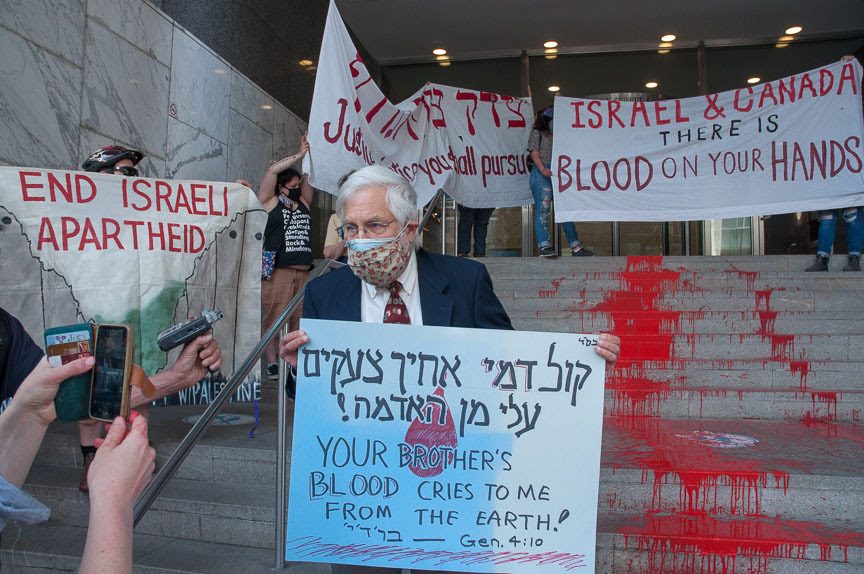
Journalists in the cross-hairs of pro-Israel lobby
We are seeing that journalists are in the cross-hairs of those who support every murderous thing Israel does. As of today, Israel has killed 26,000 people (more than half women and children) and seriously injured more than 64,000 – in 16 weeks.
Israel’s supporters include the establishment Jewish community in Canada, their mouthpieces Honest Reporting Canada and the Canadian Jewish News that routinely “out” and attempt to destroy critics of Israel and supporters of Palestine. Support also comes from major organisations such as Canada’s media empires, universities and pro-Zionist organizations which include the Evangelical Christian churches.
Our fourth estate is already teetering from job cuts, newspaper closures, and the excesses wrought by corporate concentration. Silencing journalists who want to write and talk about Gaza is another nail in the coffin.
Image at the top: typewriter keys (credit: Pixabay).
 Another ruined dinner party...