
Are 31+ storeys too high, or too low?
Today at 6 pm, the council for Halifax Regional Municipality (HRM Council) will decide whether to award Dexel Developments the right to build two 30-storey+ residential towers (with commercial space on the lower floors) on one city block bordering Spring Garden Rd, Robie St, College St and Carlton St in central Halifax.
Before you yawn and roll over, you have to know that on that same block another developer, Rouvalis and Argyris (their numbered company is 3088962 NS), has already been given permission to build two other residential/commercial buildings– each up to 31 storeys in height. You’re right: that’s four towers on a single city block.
Bear in mind that in 2019, the proposed height for
4 Fenwick towers on one city block
Think about putting four Fenwick towers, or what is now called the Vuze, on one small city block.
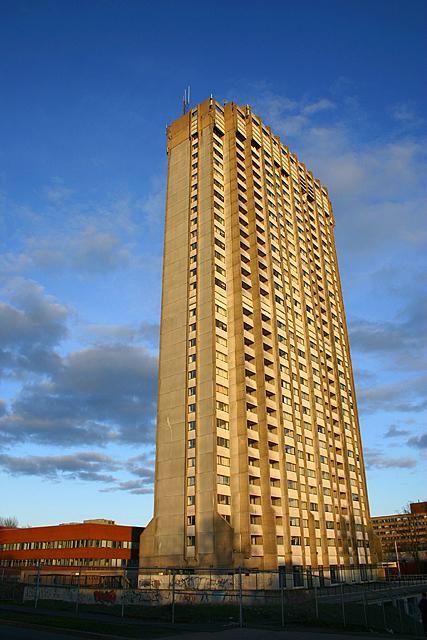
Well that’s what we are going to have at Spring Garden and Robie Streets.
Since HRM already approved Rouvalis’ two towers in 2021, it can hardly reject Dexel’s proposal – or can it? And will it? – that is the question. Both Rouvalis and Dexel had proposed buildings ranging from 16 to 30 storeys, back in 2019.
The first thing you might want to know is that there is absolutely no mandate, no provision, no plan for apartments in any of these four towers to be affordable. Not one apartment of the hundreds planned is earmarked for affordability.
As most people know, the median rent on even modest apartments on the Halifax peninsula run $2275.00 per month, that is 17% higher than the national average.
A 2022 affordability index created by RBC shows that Halifax is the least affordable of 27 cities in Canada for people aged 15-29 years. The study found that the average young person in Canada earned $20.96 per hour in 2022. In 2022, the Living wage in Halifax was $23.50 (today it’s $26.50). Across Canada, that young person runs an average deficit of $750 a month due to the high cost of living. In Halifax, the deficit shoots up 41% or $1290 per month. Every month a young working person lives here, that person goes into the hole $1290 – or about $15,000 a year!
Mason: Council can’t require affordable housing and can’t stop demolitions…
As Councillor Waye Mason said in 2021, council can’t require affordable housing, can’t stop demolitions and can’t require a carbon budget, as long as the buildings conform to the province’s Building Code—nothing can be done! So what can we do? Well we can protest, as hundreds have done through letters, petitions, appearing at council and pressuring HRM Council. But our council won’t lead, it only follows. And it follows what developers want to do.
A second thing to know is that all four brand new 30-storey buildings, when fully occupied, will put at least 1000 more cars into the centre of Halifax, every day. Rouvalis wants 500 plus spaces, and Dexel’s planning 511 parking spaces. I know, I know: if you live downtown, you shouldn’t need a car. That’s the hipster narrative. Except, if you can afford to pay about $30,000 per year in rent, chances are you can, and will afford a car (just in case, eh?). So whether you use it for occasional big-box store shopping, for groceries, to take your child to school or daycare, or to visit relatives — likely if you have a car, you will use it.
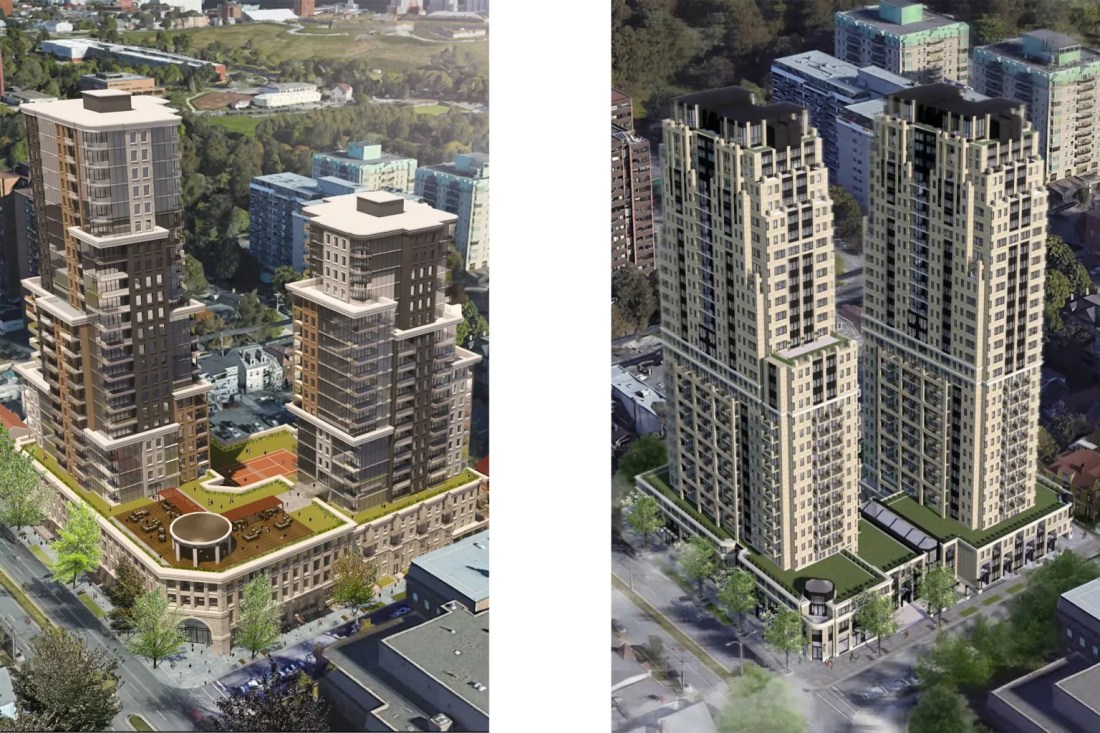
Wind & skyscrapers: downwashing, channelling and the corner vortex…
Then there is the wind. Dr Haitham Aboshosha, a structural engineering professor at TMU (formerly Ryerson University in Toronto) has studied wind tunnels in cities for more than 15 years. He says it’s not right to call them wind tunnels – really the winds created between skyscrapers are better labelled “downwashing”, or “channelling/ funnelling.” There is also something called the “corner vortex” which is created when wind hits the sharp corners of highrises and slides down to street level then affects conditions in the gap between two skyscrapers. More than 35 years ago, a blue climbing rope had to be installed along Toronto’s Front Street for pedestrians to grab for safety due to incredible downwashing winds courtesy of newly built towers. Have a look at this video:
As most of us know: Wind begets ice. Ice can cause people to slip and fall. Some people break bones and end up in the hospital’s Emergency Department. Not good.
Positive alternative…
Finally, I want to talk about positive suggestions by Development Options Halifax, a nonprofit and non-partisan organization that wants more environmentally-sound and human-friendly development in Halifax. Peggy Cameron, MES, is an environmental consultant. She published Buildings for the Climate Crisis: A Halifax Case Study HERE. She writes that the floor area of the soon-to-be demolished 12-14 historic houses in the one city block at Spring Garden and Robie is equivalent to the floor space of three four-storey buildings or a 12-storey building. She suggests these as in-fill options (rather than highrise buildings). They could accommodate just as many apartments, and that affordability could be built in—or at least considered.
“People love Halifax because of its unique character. We don’t need to look like Toronto.”
Angela Capobianco in The Coast, 2019
In this particular city block, the developers are going to demolish and displace renters in about 110 existing affordable apartment units (in the historic houses on Carlton St, and above the stores on Spring Garden Rd.). We already know that the four new towers will not offer one, let alone replace 110 affordable units.
454 demolition permits issued since 2020
Demolitions inevitably drive up the price of new apartment rentals. According to Friends of Halifax Common, since January 2020 more than 454 building demolition permits have been issued in HRM; you can see them on this map: HERE. Development Options believes that destroying older buildings affects affordability (as most of the units were affordable), community, character and the climate/ To allow the construction of four apartment towers that do not replace even one affordable unit is nasty. Especially in this housing crisis.

Cameron’s report draws attention to several other points. The two proposed developments,
“… for four high-rise towers in the Carlton Street block will have a huge and unacknowledged cost to the climate, emitting approximately 31,000 tonnes of embodied carbon in global warming emissions or carbon dioxide (CO2e) equivalents. [31,000 T are the equivalent emissions of 9,497 cars]. This number does not include the estimated 160T from associated demolitions. The majority of these GHG emissions will be released upfront before the buildings are occupied or the doors, elevators, air conditioning, parking garages etc. begin to spew operational and transportation GHGs.”
Buildings for the Climate Crisis– A Halifax Case Study, by Peggy Cameron
A 2017 study by the UCL Energy Institute found that “when rising from five storeys and below to 21 storeys and above, the mean intensity of electricity and fossil fuel use increases by 137% and 42% respectively, and mean carbon emissions are more than doubled.”
If you agree, that allowing the 30-storey buildings presents an environmental hazard, and no solutions for affordability, there is an online petition to sign HERE.
But make no mistake: I predict HRM Council will push on. They’ve already given the go-ahead to Rouvalis and they won’t say no to Dexel.
A couple of years ago I attended an HRM Council meeting to speak against one of massive tower developments. Each member of the public who signs up is usually allowed to have five minutes to address the pros or cons of what council is about to vote on. After I spoke, Councillor Mancini challenged me to explain how I was so sure that council would support the developer. I said, “In business school, we teach that the best predictor of future behaviour is past behaviour.” Sure enough, council voted for the developer.
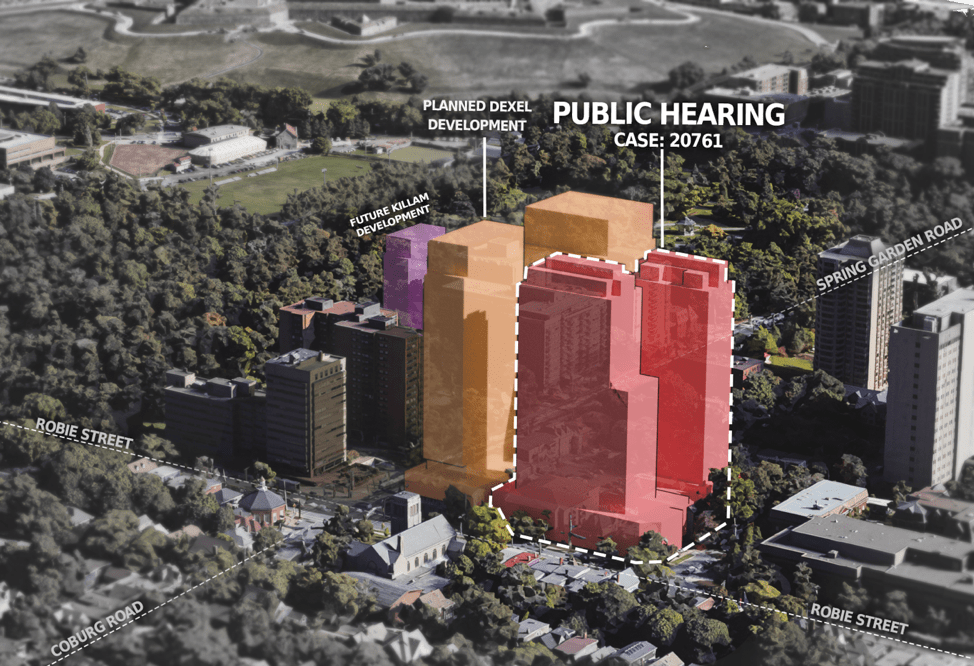
Feature drawing at the top: Drawing by Hadrian Laing. Proposed Dexel development (in orange) and Rouvalis development (in pink). The drawings show the huge massing and size of what we are going to get.
 Another ruined dinner party...