
What to Watch…here goes:
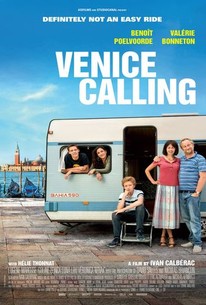
For something fun and actually pleasant to watch, see the feature film Venice Calling (Venise n’est pas en Italie) a 2019 on Kanopy. It’s a comedy and a drama about a teenage boy who falls in love with a classmate at high school, in a small city in France. She invites him to visit her in Venice during the summer, where she is playing the harp in a classical music concert. We see the chasm in social class between them. He and his parents live in a caravan (a trailer) in the back yard of an immigrant family. His girlfriend’s dad is a concert pianist; the family lives in an architecturally splendid house behind an electric fence. This is a great film, worth watching. We see that the public education system in France has thrown these two young people together. When we look at the growth in private schools in Canada (especially here in Halifax), we see how unlikely it is for a kid whose parents are barely employed to be romantically involved with someone in the bourgeoisie.
How Germans see poverty in the UK
Poverty in Britain– Why are millions of Brits so broke? is a 2022 DW Documentary from the German public broadcaster. You can see it here.
In a suburb of London, meet Naomi. She and her husband have a 6-month-old baby. Both parents have jobs, but Naomi’s maternity leave is indefinite; in fact she probably cannot return to her job. Though she is a manager at a computer firm, she can’t afford childcare which works out to more than the £80 a day she nets at her full-time job. The couple own their own home, have an income of £3,500 pounds a month (more than C$5,800) but food prices alone have gone up more than 14% in the last year. They can only afford to heat one room at a time– and that is their kitchen. The filmmakers then go to Blackpool which is near the top of impoverished cities in the UK. One in 3 jobs depends on tourism—and poverty wages. Though Blackpool gets more than 18 million visitors during the summer months, for 6 months of winter, people literally starve. Thousands are homeless. This documentary is an excellent glimpse at what Canada will turn into – unless things change.
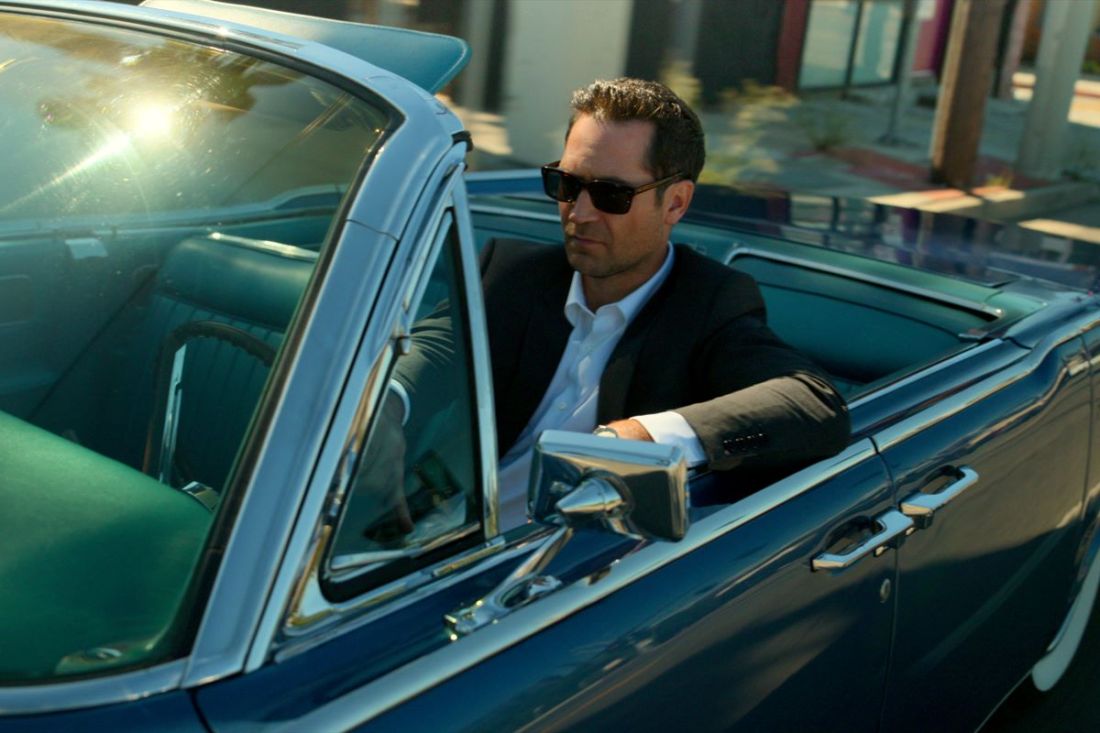
I watched season two of The Lincoln Lawyer on Netflix. I wasn’t all that impressed with the first season, but the second is bingeworthy. Mickey Haller, a 40-something Mexican-American lawyer is dragged into a murder case. He represents an attractive woman, Lisa, who owns a restaurant and bar in an area of Los Angeles that is undergoing gentrification. A local wealthy developer has been destroying homes and businesses in the neighbourhood. She has led protests about his block-busting. You’ll like it for the twists and turns in the plot and his qualms about Lisa’s innocence. Here is the trailer.
Is eco-terrorism terrorism?
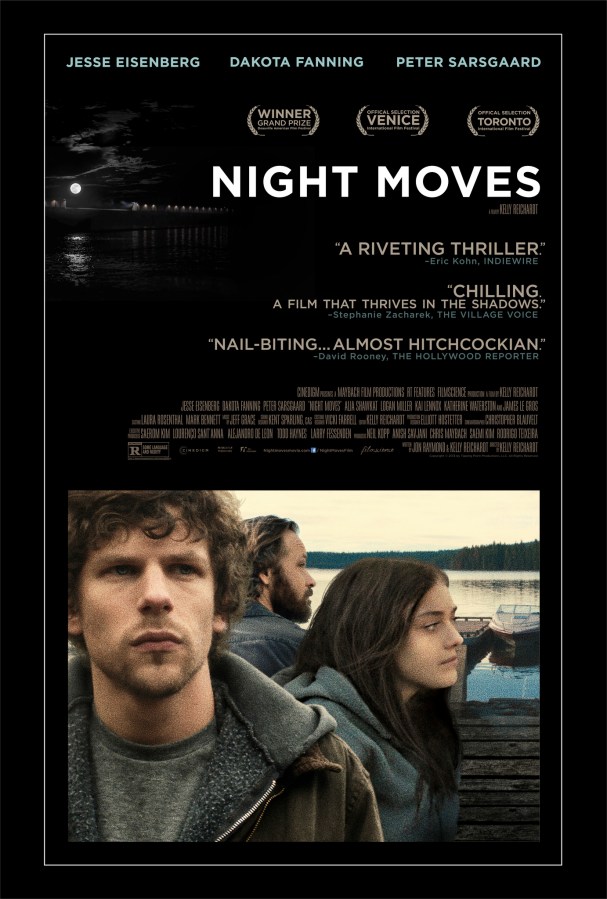
On Kanopy, Night Moves (2013) is full of suspense and quite good. Three environmental activists in Oregon plot to blow up a hydroelectric dam. All three characters are well-drawn and believable. What happens is not what you think, and yet credible. Here is the trailer.
Also on Kanopy, you could watch Los Lobos. This 2020 feature film is a sensitive and sensible portrayal of the life of a Mexican mother with her two sons, age five and eight who move to Texas to make a new life. She has to work long hours at a low paid job in a commercial laundry, and as a cleaner. She leaves both kids alone all day in their bachelor apartment furnished with one deck chair, dirty wall-to-wall carpet, a broken kitchen cabinet and a kettle. They can’t afford beds, so the family of three sleeps together on bedding piled on the carpet. Rather than yelling at the kids, the mother leaves a tape-recorded message with the rules governing what the kids can and can’t do during their long days alone. There is an element of suspense that is well done. The monotony of the boys’ days fuels their hopes that their mom will live up to her early promise to take them to Disneyland. Here’s the trailer. It’s quite wonderful.
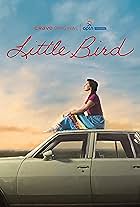
Below: top: Scene of the rail car pile-up in Lac-Mégantic (The Globe and Mail); the two boys playing in the empty apartment in Los Lobos; poster for Little Bird; Lincoln Lawyer on the road; poster for Venice Calling.


Two excellent new Canadian series…
A friend suggested I watch Lac-Mégantic: This is not an accident – it’s a four-part documentary series about what really happened in the railway disaster of 2013. It’s a politically charged and thoughtful film that answers many questions that the media, the government and the rail corporations refused to honestly address. You will not take your eyes off the screen. Here’s the trailer.
The most breathtaking dramatic series I’ve watched is Little Bird. The year is 1986. A 23-year-old woman who has recently finished law school at McGill University in Montreal, is guest of honour at her very ritzy engagement party. Her mother and father, both lawyers, her fiancé, a medical doctor, his whole family as well as dozens of friends are present. The young woman, Esther, was adopted by Jewish parents when she was five-years-old during the ‘60s scoop. She is Indigenous, yet was raised in a traditional and observant Jewish family. She wears a silver star of David around her neck. Something happens at the engagement party which forces her to confront her Indigenous status, and her future in the tight-knit Montreal Jewish community.
This series, produced by APTN, is brilliant. With a very light touch, award-winning Canadian playwright Hannah Moscovitch manages to present us with a nearly untenable situation. The series exhibits sentiment, but clear-headed understated feelings that will knock you sideways. The acting is thoughtful, and the characters are non-formulaic. You won’t easily forget Little Bird. Highly recommended. It’s on CRAVE. Watch the trailer.
A couple of years ago, I read Moscovitch’s excellent play, Sexual Misconduct of the Middle Classes, which won the 2021 Governor General’s award for English-language drama. It too is well worth reading.
I was reading the British online left journal called Coldtype here, and saw an excellent review of the play on in London, An Inspector Calls. Prominent English author, and socialist, JB Priestly, wrote the play during World War II. Yet despite his renown, no theatre in Britain would mount a production of this anti-capitalist and very stirring play. Accordingly, it was first produced on stage in Moscow, in 1945. An Inspector Calls takes place in 1912, in the dining room of a wealthy family; the patriarch is a textile factory owner in the north of England and the mother does charity work. The family is celebrating their daughter’s engagement to a young well-heeled man. Suddenly, the maid comes in to tell them a local police inspector is at the door and wants to talk to the man of the house, with the family present. I won’t say more but here is the trailer for the 2015 version that I watched. There are several other versions; you can watch the excellent 1954 version free on YouTube. Or the 2015 that I saw was on Paramount. You can sign up for a free seven day trial, which you can cancel anytime after watching An Inspector Calls.
What to Read…
Since it was summer, I read two very long books of fiction by writer Richard North Patterson. One, Conviction, is a court room epic about a 35-year-old Black man, Rennell Price, who has been on death row in San Francisco’s San Quentin prison for 15 years. Price was convicted of the sexual assault and murder of a nine-year-old Korean-American girl, whom he abducted on her way home from school. He has maintained he never did it. Terri Paget is a lawyer who fights against capital punishment. She fights to either commute the death sentence to life in prison, or to exonerate the defendant in the case he was wrongly convicted. A fascinating– if detailed — read. Why not read a free excerpt from the e-book here.
The second Richard North Patterson novel I read was Loss of Innocence, about radicalism and love, in the US in 1968. North Patterson who specializes in court room dramas and legal/procedural books wrote this book in 2013. He notes that it was his way of coping with the fallout and racial tensions caused by deaths of Martin Luther King Jr and Bobby Kennedy. I gather they were Patterson’s heroes. In the book, a 22-year-old woman of privilege, Whitney Dane, returns to her parents’ home in Martha’s Vineyard, Cape Cod for the summer to prepare for her September wedding. Recently graduated from an ivy-league college, she has no special career ambition but she loves literature and writing. Her fiancé, also a recent college grad, has a job in her wealthy father’s business. Dane’s world begins to fall apart – her parents are ardent and active Republicans; they fully back Richard Nixon, their candidate for US president. Dane favours the Democrats and is against the war in Vietnam. Her volunteer job takes her to poor Black areas of New York; she begins to see what’s really going on. She befriends an impecunious young man who dropped out of college, and wants to be a journalist. Her parents are scandalized by the relationship, as her wedding is weeks away. Dane’s character is a bit obtuse – still the book is about the huge swing the 60s had on life in the US.



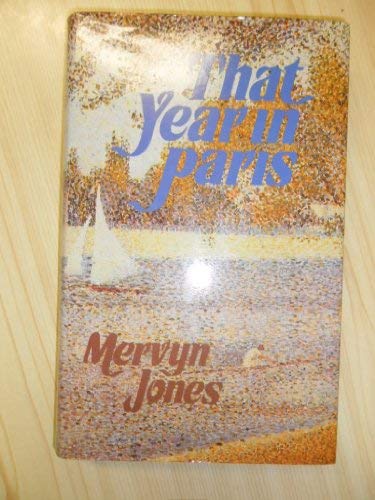

There’s a better book about an American woman’s take on 1968. That book is British novelist Mervyn Jones’ That Year in Paris (1988). It’s a wonderful read about a woman’s view of the politics of revolution in Paris ’68, set against the backdrop of the Vietnam war. Hard to beat this book!
Vietnam – bringing the war home to Canada
While I’m on the subject of the Vietnam war, there is a new Canadian young adult fiction book Focus. Click. Wind. by Amanda West Lewis. It’s fast-paced and good. In 1968, Billie lives alone with her mother in New York City. She’s in grade 11, a talented photographer, she is involved with the anti-war movement. Her boyfriend, a first year student at Columbia University, is heavily involved in campus struggles against the draft, and exposing the university’s corporate ties to the military-industrial complex. Billie’s mother – also an anti-war sympathizer — decides she and her daughter have to move to Toronto, mainly to get away from the violence besetting most American cities, and for the chance to help draft dodgers. This book is a time-travel tour of Toronto in the 60s. From Jarvis Collegiate, where Billie goes to school, to the American exile radicals groups at the old 44 St George St., to demonstrations in front of the US Consulate, the book feels like 1968. Billie herself, is a hard-edged person who evokes limited sympathy. Intense and inspired by American photographer Catherine LeRoy, Billie thinks her own photos could contribute to stopping the war.
Billie gets involved with deserters who have a plan to stop the shipments of Agent Orange from leaving a factory outside of Toronto. The book is suspenseful, and emotionally charged. Worth reading. In addition, to read a very good article about how Prime Minister Lester Pearson, and the Canadian military worked hand in glove with US imperialism during the Vietnam war, read this post by Yves Engler.
Climate Consciousness
Since we’ve just had the climate “strike” in cities worldwide, now is the time to read Caitlin Johnstone’s excellent article: Humanity’s Single Common Foe here as she points out
“It’s no longer about nation versus nation, ruler versus ruler, group versus group, person versus person. It’s about humankind versus extinction. It’s a fight that can only have one winner, and it’s a fight we can only win together.”
British writer Jonathan Cook, is a trenchant critic of capitalism and US imperialism, and has written three excellent books about Palestinians and Jews. His article on his Substack here is well worth reading, Why action on the climate crisis is all hot air poses many questions. In it he tries to address,
“So how did we reach this point of abject failure: where the greater the scientific consensus, and real-world evidence, the smaller the impact that consensus has on decision-making?”
What podcasts to listen to…
I am more and more impressed by Canadian True Crime, hosted by Kristi Lee, an Australian who “now calls Canada home.” I’ve reviewed her excellent investigative series on the murder of a Toronto bike courier, The Death of Darcy Allan Sheppard here. Now she’s turned her attention to a new and disturbing cause, The Legacy Academy Scandal. The three-part series is about Saskatoon’s Christian Centre Academy. Eighteen brave ex-students, led by Caitlin Erickson, have exposed this evangelical Christian school for its use of corporal punishment, sexual grooming, assault on minors and the anti-LGBTQ+ actions of school administrators and some teachers. The podcast is fascinating for a number of reasons. First, these young people dared to break away from the mind-numbing cant of the school; secondly the police have laid charges against many of the school’s administrators, and finally, some of these young people lost their families, friends and community because they dared to stand up. I have a long-time interest in evangelical Christianity and right-wing politics as I wrote one of the first Canadian investigative books on the subject Faith Hope No Charity An Inside Look at the Born Again Movement in Canada and the United States (New Star Books, 1985). You can find the book at most public libraries in Canada. Listen to The Legacy Academy Scandal here.
Opioids, and the Sackler ‘brand’
Now I am listening to Canadian True Crime’s The Truth about Canada’s Opioid Crisis. The three- part series is excellent, thoughtful and focused. Listen here. It can be followed up by this 6-part TV drama series Painkiller on Netflix, that I found a bit sensationalistic. The book about the opioids crisis I highly recommend is Empires of Pain, by Patrick Radden Keefe. The book is a deep examination of the Sackler family and their Purdue Pharma — manufacturers of OxyContin. A brilliant and scary book. Read about it here.
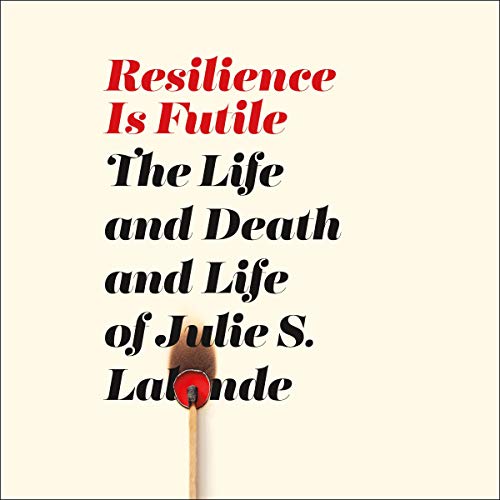
Finally, The Big Story podcast has an excellent interview with Ottawa author and women’s rights advocate Julie Lalonde. I reviewed her groundbreaking book Resilience is Futile: The Life and Death of Julie S. Lalonde on my blog here. The topic of today’s podcast is The long road to an ‘epidemic’ of intimate partner violence’. Well worth tuning in here. Equity Watch features a lively interview with Lalonde that you can watch here: “Why the toxic misogyny in command and control organisations (police, fire, military)”.

NOTICED: Canada Post promotes Feminists
I knew Madeleine Parent. I recall going to the apartment she shared with her husband Kent Rowley, also a formidable labour union leader, in Brantford, Ont. It was 1970, years after she and Kent, were thrown out of the UTWA (United Textile Workers Union of America) after sanctioning an “illegal” strike at Valleyfield, Quebec and for being Communists. Parent and Rowley founded a new Canadian union the Canadian Textile and Chemical Union (CTCU), and later a new labour centre, the Confederation of Canadian Unions (CCU) in 1968. At that time, about 75% of unions in Canada were American unions headquartered in the US. Canadian members’ dues went south– as they do still. But today three quarters of Canada’s unions are Canadian-based. Parent and Rowley’s union organizing and activism were in part responsible for that change for the better. I later met Parent at a couple of union conferences, and once at the National Action Committee on the Status of Women (NAC) conference in Saskatoon in 1993. For a short bio on Parent, read this.
Featured image at the top: Flood warning. by hahatango, Flickr, CC BY 2.0
 Another ruined dinner party...
Thanks for recommending Focus. Click. Wind, Judy, and for understanding that these are such important dialogues to be having. I love that you have linked to Catherine Leroy and to Agent Orange, which remains a contaminant in the ground outside of the former factory in Elmira, Ontario. Yes, the discussion about complicity is a vital one now, and always.
LikeLike
thanks amanda, please subscribe to my blog! And your book Focus.Click.Wind. was excellent. Agent Orange is an ongoing concern in Gagetown NB here: https://www.canada.ca/en/department-national-defence/corporate/reports-publications/agent-orange.html — the feds have tried to bury evidence and the issue entirely. regards judy
LikeLike