

According to B’Tselem, some 2,171 Palestinian children have been killed in the last two decades by Israeli military actions
Judy Haiven / September 19, 2023 / 5 min read. Published in Canadian Dimension here

While reading Focus. Click. Wind., a new Canadian novel by writer and theatre director Amanda West Lewis about Vietnam War resisters in Toronto in the 1960s, I came across the name Paul Schutzer.
Some may recall that Schutzer was an American photographer for Life magazine. He died at age 36 in 1967, during the Six Day War. He was killed in a tank while covering the war for the magazine. His photojournalism is exceptional. Today I looked back through his photos of the early days of the US war in Vietnam in the mid-sixties.
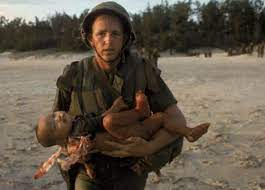
Looking further, I found a dozen photos, often by award-winning photographers, that purported to show the humanity and kindness some US soldiers showed to children in Vietnam.
What strikes me is that interspersed with photos of US troops running with guns and bayonets, and their wanton destruction of the lush jungles, setting fire to homes and villages, we see something else some US soldiers did or wanted photographers to see them doing.
In some photos, we see US soldiers carrying and cradling young Vietnamese children. We see a soldier taking a child to medics to be patched up. Photos show terrified children, running from houses burned down by American troops, their parents killed or missing—some soldiers who just committed unspeakable horrors yet they tried to console the children. This was a human response to tragedy—albeit a tragedy inflicted on the Vietnamese people by the American war machine.
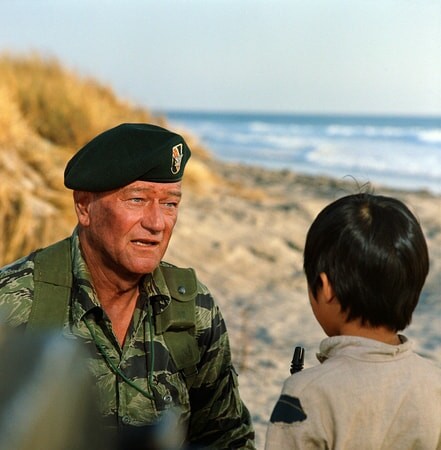
In 1967, a Hollywood studio (under the approving eye of the US military and President Lyndon B. Johnson) produced a pro-Vietnam War movie, The Green Berets. A box office success, the film earned a substantial $32 million ($278 million in today’s money). John Wayne, the film’s director and star, was a rabid anti-communist and backer of the war. But in the US, there was mounting opposition to the war. Wayne and company wanted to reverse it and boost America’s commitment to the war effort. The plot of the movie includes a Sergeant Peterson who takes a fatherly interest in a young Vietnamese orphan, Ham Chuck, and his dog Jamoke. Of course, Ham Chuck’s parents had been killed by American forces. Peterson ultimately dies a hero’s death, and Ham Chuck—fostered by Peterson—is left once again without a father. A grief-stricken Ham Chuck is assured by one soldier, “You’re what this war is all about.”
By comparison, let’s look at today’s “war” between Israel and Palestine. This “war” is not a war at all. The Israelis are taking land from the Palestinian people. Since 1948, successive Israeli governments have authorized their troops, along with more than 700,000 settlers, to confiscate Palestinian homes, destroy the buildings at will, and throw Palestinians off their land. Israel, the last colonial settler state in the world, has illegally colonized East Jerusalem, the West Bank, and Gaza since 1967—despite more than 150 resolutions by the United Nations aimed at curbing Israeli aggression against the Palestinians.
Are there any photos of “the most moral army in the world” saving a Palestinian child?
Given that, we have yet to see a photo in the last 20 years in which an Israeli soldier offers comfort to even one Palestinian child. In fact, the Israelis are seldom (if ever) blamed for killing Palestinian children, many of whom are disabled and cannot or do not follow soldiers’ orders to stop, to turn around or to get on their knees in preparation for arrest.
Take the case of 32-year-old Eyad al-Hallaq, a profoundly autistic man with a mental age of eight. In May 2020, he was walking from his mother’s home in East Jerusalem to his school for the disabled when four armed Israeli policemen, allegedly looking for a an “armed terrorist,” followed al-Hallaq and his teacher into an alley (the two were not armed). The student tried to hide in a garbage room in the school’s basement while the teacher kept yelling at the police to back away. “Nakheh, nakheh [‘disabled’ in Hebrew],” she pleaded, but a policeman fired three shots into the tiny garbage room, killing al-Hallaq. This year, the cop was acquitted, as he was found to be acting in “good faith.”
In November 2022, Fulla Masalmeh, a 15-year-old, was a passenger in the car of a 26-year-old man in her West Bank village of Beitunia, located 14 kilometres north of Jerusalem. Israeli soldiers opened fire on the car—despite the fact that three independent witnesses say the driver did nothing wrong. Fulla, a vulnerable girl one day short of her 16th birthday, was autistic and, according to her sister, “did not know day from night”. She had accepted a ride from a neighbour. She was killed when soldiers fired two bullets into the car after it had come to a stop.
86% of Palestinian child detainees were beaten, 42% were shot and/or had bones broken when they were arrested…
It’s not just the cold-blooded murders, it’s also the fact that between 500 and 1,000 Palestinian children are locked up every year in Israeli prisons. New research from Save the Children notes that, “The main alleged crime for these detentions is stone-throwing, which can carry a 20-year sentence in prison for Palestinian children.” In the report, 86 percent of 228 former detainees were beaten, 69 percent were strip-searched and 42 percent were shot, had bones broken or other injuries at the point of their arrests. From 2000 to 2021, Israel arrested more than 12,000 Palestinian minors, aged 10-18.
This is not new. Israel’s policies and Zionist culture have profoundly reduced, dehumanized, and tried to erase the presence and the lives of Palestinian children (and adults) for decades. As Israeli journalist Or Kashti writes in Haaretz, the government continues “to plaster over any crack in the dehumanization of the Palestinians, from the first grade to the grave.”
This is borne out by the most recent action taken in August by Israel’s Ministry of Education. The government has banned the NGO, Israeli Palestinian Bereaved Families for Peace, from speaking at all schools in the country. The organization, which was established 20 years ago, is well-recognized for bringing students and bereaved family members—both Israelis and Palestinians—together to talk about their pain and grief, and contribute to reconciliation.
Nine months ago, the Israeli government started to require any NGO programs or speakers in schools to pledge that their content contains no “degradation or humiliation of the Israel Defense Forces, fallen soldiers, or victims of hostilities.” Clearly the wording was aimed at forbidding bereaved families, among others critical of the occupation, from speaking to, and influencing, young people.
These groups are simply trying to humanize the Palestinians, and support their fundamental right to lives free from persecution.
Why no photos of Israeli soldiers caring for a Palestinian child?
Perhaps this is why we see no photos of even one Israeli soldier caring for a Palestinian child, injured, frightened or dying on the streets of East Jerusalem, West Bank towns and Gaza which are the battlefields. Israel does not seem to care what images it portrays to the world.
Note: for more on the 2171 Palestinian children killed by Israel, read this. For further proof, read this article in Mondoweiss here
Featured image at the top: A mural depicting Eyad al-Hallaq, age 32, on the apartheid wall in Bethlehem, on the West Bank. Al-Hallaq was a young autistic Palestinian who was killed by the Israeli police in Jerusalem. See the article above. This photo of the wall was taken in June 2020. (Wikimedia Commons).
Judy Haiven is a member of Independent Jewish Voices Canada. She is a retired professor of management at Saint Mary’s University in Halifax. A member of the editorial board of Canadian Dimension, this article is her own opinion.
 Another ruined dinner party...
Dear Judy,
Your writing is heartbreaking & powerful! The photos you selected are touching as well!
I was especially moved by the American medic carrying an injured Vietnamese baby!
Violet
LikeLike
thx very much
LikeLike