We all know what’s coming.
Sometime today, the city will grudgingly send buses or taxis to the parks and places where people have pitched their tents in HRM. They will be offered a ride to one of three or four church basements and community centres strategically opened around Halifax that have been turned into emergency shelters in preparation for Hurricane Lee making landfall in Nova Scotia.
Now there are tents in the cemetery in Dartmouth, and in the woods adjacent to Cobequid Community Health Centre in Lower Sackville. There are tenters near the Sobeys in the Larry Uteck area, at Victoria Park in Halifax, and at the Grand Parade. There are probably five or ten more tent encampments around HRM. There are hundreds of homeless people living rough in tents; some are old, some younger and many with disabilities.
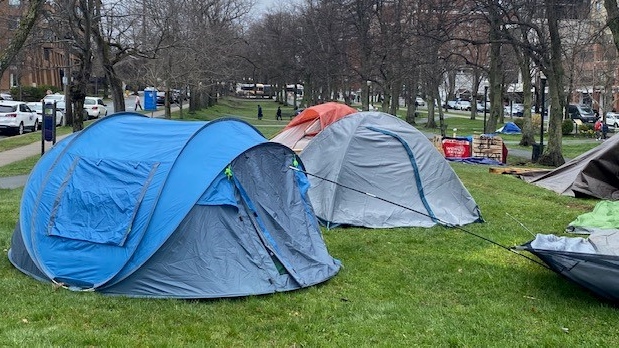
Frost will arrive in the next four to six weeks. Before then, there will be perhaps three or more hurricanes (or tropical storms) and major rain/wind events. If the forecasts are dire enough, the tent dwellers might get the opportunity to stay for a night or two in a hotel, on the provincial government’s tab. Then they will have to return to live in their tents in parks, parking lots or wooded areas until the tourist season fizzles out.
Hotels, now gouging tourists with high room rates, will accept the $100 plus a night offered by Social Services to briefly house the homeless in winter
Only then – generally after Christmas – will hotels be willing to house the homeless through the toughest weeks of winter. Hotels will gladly do this– first because the government (usually Community Services) picks up the tab, and secondly because around New Year’s, hotel occupancy takes a nosedive due to lack of tourism and a shortage of business travellers.
We’ve seen this all before. Every year we hold our breath in anticipation of one or more people who are houseless, possibly perishing in their tents. Every year scores of people who are living rough visit hospital emergency rooms for treatment for burns from small fires or propane stoves used for heat. Some people are hospitalized for frostbite, the flu or pneumonia, the latter two can kill. Or they walk to hospital waiting rooms without scarves, mitts, winter clothing, and bootless– sometimes wearing cut-up sneakers. The people in tents do this to escape the bone-chilling cold, if only for a day. During those really cold days, we might deign to offer them warming centres. But they are only open till early evening. Later, it’s expected they can go to an overnight shelter. But there are not nearly enough beds; they are violent places where people’s few possessions can be stolen or ruined.
HRM Council does not inspire confidence
HRM Council decided on four courses of action at their Tuesday meeting; none were particularly inspired. One thing they agreed on was to find more land, or parks, or pay for private space for the homeless to pitch tents. How is that going to help with winter around the corner?
The second decision they made was to build more modular housing and some tiny homes too. Modular housing in HRM consists of attached single rooms furnished with a bed, a shelf, some cabinets, heating, and a window that opens. There is one bathroom to share for every three residents. There are no cooking facilities in the rooms. While the situation might accommodate single men , women or women with children can’t be expected to live in them. There are more men than women who live in modular units — do the handful of single women seriously want to share a bathroom with men? I doubt it. Our city spent $4.9 million to build modular housing that accommodates 26 people at Alderney in Dartmouth, and 38 people near the Centennial Pool in Halifax. That works out to a cost of $76,562 per unit.
According to HRM’s director of housing and homelessness Max Chauvin, a tiny home is basically a room with a toilet, a shower, and a kitchenette. It’s a place “someone can call home and feel safe and comfortable,” Chauvin told the CBC’s Portia Clark on Information Morning . Tiny homes are usually 250-400 square feet in size, approximately one-eighth the size of an average home. How could a woman with one or even two or three kids live there?

I question how a woman with children could live in a tent, or in modular housing or in a tiny home because just this week we found out that it can take years for a woman-led family that has fled an abusive partner to get into public housing. The cost of rent for market housing is simply unaffordable for most women who have to flee their abuser. The CBC interviewed one woman in her 60s who finally left an abusive partner. She gets $950 a month on social assistance, but average rents in Halifax are nearly double that figure.
This year NS Status of Women’s office provided $7,405,345.00 for the 11 transition houses in the province – that is an average of $673,213.00 for each refuge. Not much when we consider the 4,200 women served by the province’s transition houses last year. It works out to $160 per abused woman. Hundreds of women and children are now at risk of returning to their abusive spouses because they can find no affordable long-term housing.
This is despite the NS government’s handwringing and solemn promises in the wake of the findings of the Mass Casualty Commission. Its recommendations include: putting women’s safety first, the adoption of strategies against gender-based violence, performing women-centric risk assessments of situations in which many women find themselves and addressing coercive control as a form of gender-based intimate partner violence
Our governments have done precious little to implement these recommendations– despite the $30 million spent on what’s commonly called the Portapique Inquiry. Much of it focused on the risk to women of living with abusive partners.
Wanderers FC proposal could earn the club nearly a quarter of a million dollars — every game
Today’s news is especially hard to take. President and founder of the Halifax Wanderers FC, Derek Martin, has rolled out a new plan for a permanent stadium smack in the middle of downtown Halifax, adjacent to the Public Gardens. Martin is asking HRM to put up $40 million to build a stadium (where the temporary one is) on public land that is part of Halifax Common. It’s big of Martin to announce HRM will own the stadium, and the Wanderers can pay it back over 30 years – at the rental rate the rate of $2,800 per game!
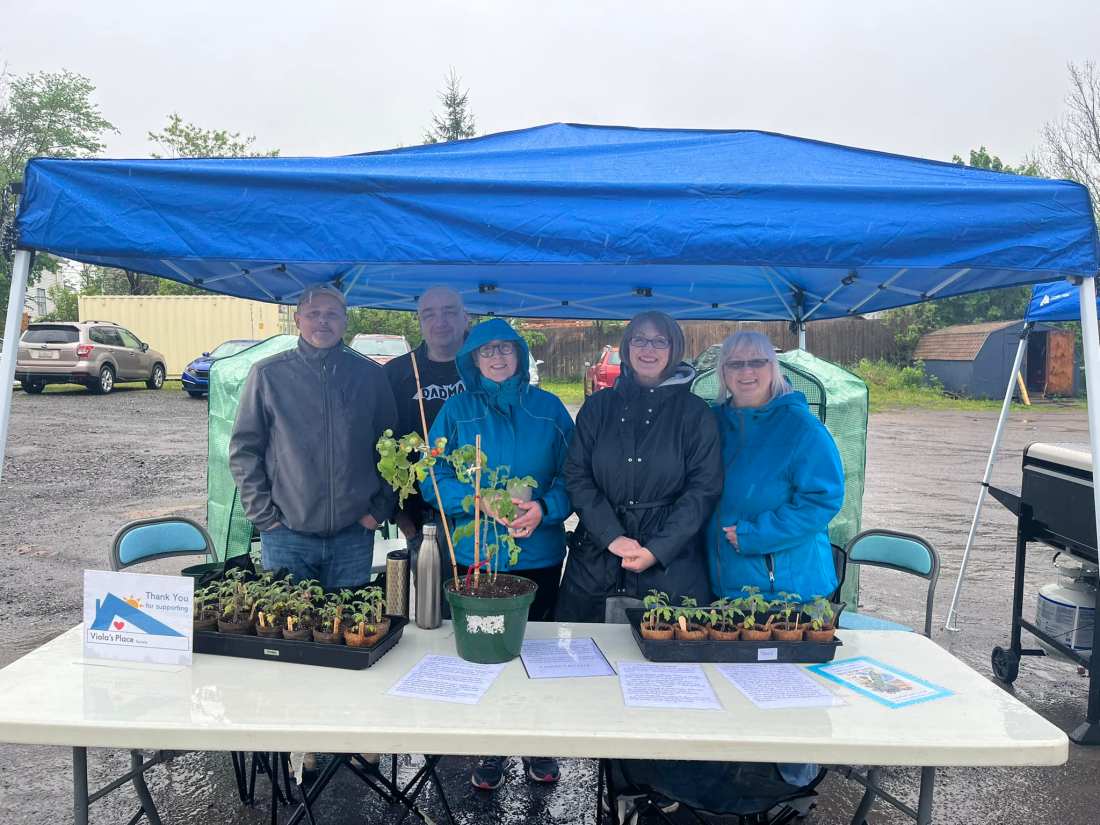
The two photos below tell the tale. The proposal from a for-profit sports/entertainment company, Halifax Wanderers FC, calls for HRM to build a $40 million stadium, which the club can lease over 30 years. Women who support the non-profit Viola’s Place Homeless Shelter have to rely on small donations and a plant sale just to keep their shelter open.

The new stadium will have room for more than 8,500 fans. At $30-$40 a ticket, if even 7,000 bought tickets, the Halifax Wanderers FC would earn nearly $250,000 per game. And that money goes to the club, its players and its owners as it is privately owned.
This can’t be serious; our city that does so little for the homeless may spend $40 million on a sports stadium.
“They could see the future, they assured us. But now, those very same people are singing that no one could predict the future.”
Tim Bousquet, July 13, 2020 about the Convention Centre boosters, in The Halifax Examiner
I don’t care how many games, are mounted at the new stadium – it looks like another case of HRM’s eyes being bigger than their stomachs. Just down the street from the proposed stadium is the Halifax Convention Centre. It ran a deficit of $7.5 million in 2022-23 and HRM taxpayers are on the hook for half of it. And for what? It is widely reported that conventions are in decline. As journalist Tim Bousquet noted sarcastically three years ago, supporters of the Convention Centre were so wise:
“They could see the future, they assured us. But now, those very same people are singing that no one could predict the future.”
A Virtual Disaster, the Halifax Convention Centre in the Halifax Examiner, July 13, 2020
It’s true COVID didn’t help matters – in 2020 the deficit was $11 million. Many, including me, campaigned against building the Convention Centre, a white elephant that was going to cost us money and provide HRM residents with virtually no benefits.
Oh that reminds me. For the winters of 2021 and 2022, Edmonton Convention Centre was turned into a shelter for the homeless. There was very little vandalism. Edmonton mayor Don Iveson said “Out of a $10-million effort to save lives over the winter” the city only spent “six figures” to replace some carpet, some glass and lighting fixtures. Perhaps we should put our homeless people in the Halifax Convention Centre – or would that be rubbing the city councillors faces in the dirt.
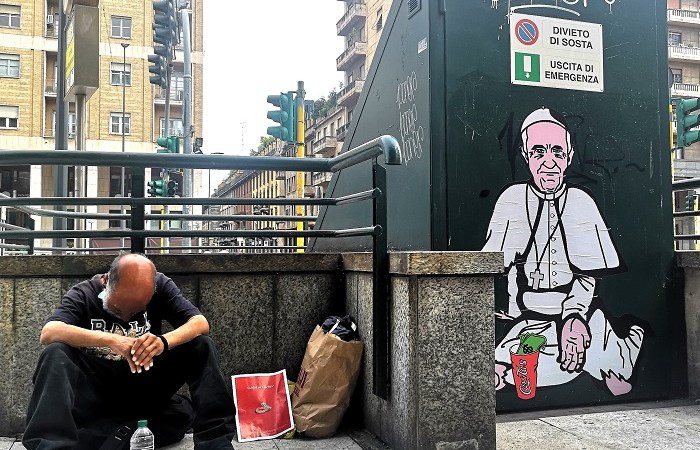
Featured photo at the top: aleXsander Palombo depicts Pope Francis as a homeless man, begging, in this street art in Milan, Italy. (photograph from The Big Issue, UK. For more on Palombo read this.
 Another ruined dinner party...