
I have watched and waited every day since last Thursday when Canada’s Governor General Mary Simon announced the recipients of the Order of Canada.
Sure enough it was the long weekend, but I didn’t see any media outlet in this town take special note of Dr Lynn Jones having won it.
Yet often they do make note – and write at length (other than publishing a list) about Nova Scotians who receive the award. In a cursory glance at coverage of OC winners in 2020, for example, all three Nova Scotians (white men) merited descriptions and nice quotations. Here’s a Globe and Mail article about the 2022 recipients which featured home-grown Sidney Crosby. As recently as June 30, Nova Scotia’s Saltwire carried a major story on a retired Ottawa Citizen columnist — a man — who received the Order of Canada. He had little to nothing to do with Nova Scotia.
Dr Lynn Jones was awarded the Order of Canada “for her leadership in the Canadian labour movement, and in advancing equity, justice and human rights in her province and abroad.”
However on the upside, today CBC Radio’s Information Morning, host Portia Clark interviewed Jones. As I understand it, the interview didn’t happen until someone had phoned in to suggest it.
The woman who received the award last week, is Dr Lynn Jones. Black ‘archivist’ and historian, community leader, union activist, and friend to many who fight for social justice – and foe to the powerful white cliques that have run this place for a very long time. She won the Order of Canada (OC) “for her leadership in the Canadian labour movement, and in advancing equity, justice and human rights in her province and abroad.”

Some people will have heard of Lynn Jones because four years ago, she donated her incredible collection of newspaper clippings, pamphlets, magazine articles, memorabilia, obituaries and more about the last 50 years of Black and marginalized people’s lives in Nova Scotia to Saint Mary’s University. The clippings reveal the communities’ struggles with policing, racism, employment, union advocacy and the broader Black world.
Jones was one of ten children born to two civil rights activist and community-focused parents in Truro, NS. As she recounts in an excellent 30-minute video which introduces the Lynn Jones African-Canadian & Diaspora Heritage Collection, she started collecting at the age of eight. She explains that as a child she remembers her home possessing many papers and the dining room table was a repository to clippings about the Black and wider community.
As Jones points out, this was a time that no one talked about the legacy—or even the existence — of slavery in NS; no one talked about what happened (and still does) to Black children in the hostile education system; no one talked about reparations to African Nova Scotians for the systemic wrongs done to them. Some articles in the collection draw attention to the anti-Black bias in policing; there are “incident reviews” that she and other members of the Black community wrote up after a set-to with the police. She laughs when she admits the community’s view and what the police say happened are two different things. Yet, she notes, in response her community convened Black Family Meetings, in which the community got together without outside influences to frankly discuss racism and discrimination and what to do about it.
A leader in her union, the PSAC (Public Service Alliance of Canada) she worked in the federal public service, and fought to boost human rights, and eradicate racism.
In 1992, she was elected a General Vice-President at the Canadian Labour Congress (CLC)– the first Black person to occupy the position. She was also a national vice-president of the Canada Employment and Immigration Union.
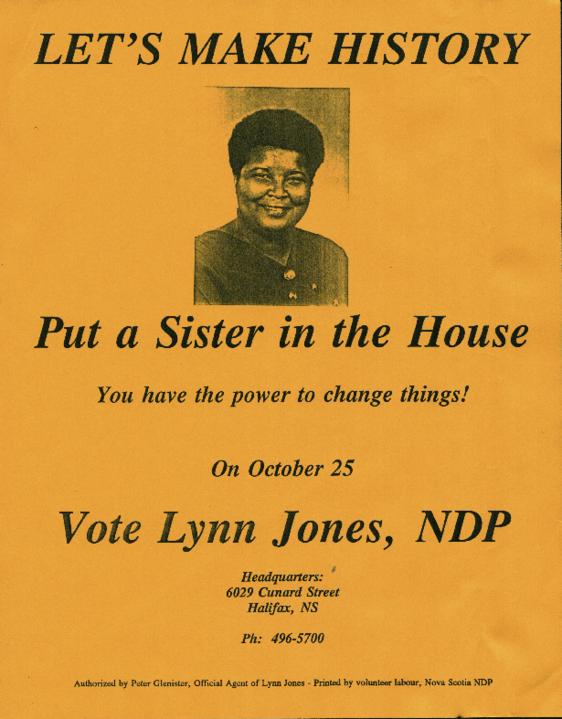
In 1993, Jones became the first African-Canadian born woman to run in a Canadian federal election, as the NDP candidate for Halifax. In the 1990s, Jones co-chaired the CLC National Anti-Racism Task Force—the first ever widespread examination of racism in the Canadian labour movement. It resulted in a groundbreaking final report that demanded bold measures to address racism internally.
She is currently the chair of the Global Afrikan Congress (Nova Scotia Chapter), which seeks reparations for the trans-Atlantic slave trade. Other areas of interest include environmental racism, securing affordable housing, fair wages. She currently chairs Down The Marsh Community Land Trust, one of the first two Black land trusts in the province.
In 1994, Jones was selected to be an observer to the first free elections in South Africa. She had to wake up at 4 am to attend a rally featuring Nelson Mandela vying to become the country’s leader, and was with the huge crowds who waited till after 7 pm for him to speak – “but I wasn’t tired at all,” she recalls.
Before receiving the Order of Canada, Jones was honoured with the Queen’s Medal, the Congress of Black Women of Canada’s Women of Excellence Award, the Nova Scotia Federation of Labour Human Rights Award, and two honorary doctorates as well as several other distinctions.
She is currently the chair of the Global Afrikan Congress (Nova Scotia Chapter), which pushes for reparations for the atrocities of the trans-Atlantic slave trade. With the Global Afrikan Congress, she helped bring to publication R is for Reparations, the first children’s book in the world to address reparations.
I don’t know what it takes for the media around here to take note of excellence and put fact to print. Suffice it to say maybe now that I’ve scratched the surface, they’ll pick up the Dr Lynn Jones story from here.
Featured photograph: Lynn Jones photo by Kyah Sparks/CBC. See this article about Jones and Emancipation Day, 2021.
 Another ruined dinner party...